

Galerie Wolfgang Jaenicke
This fragmentary Tada sculpture
This fragmentary Tada sculpture
Couldn't load pickup availability
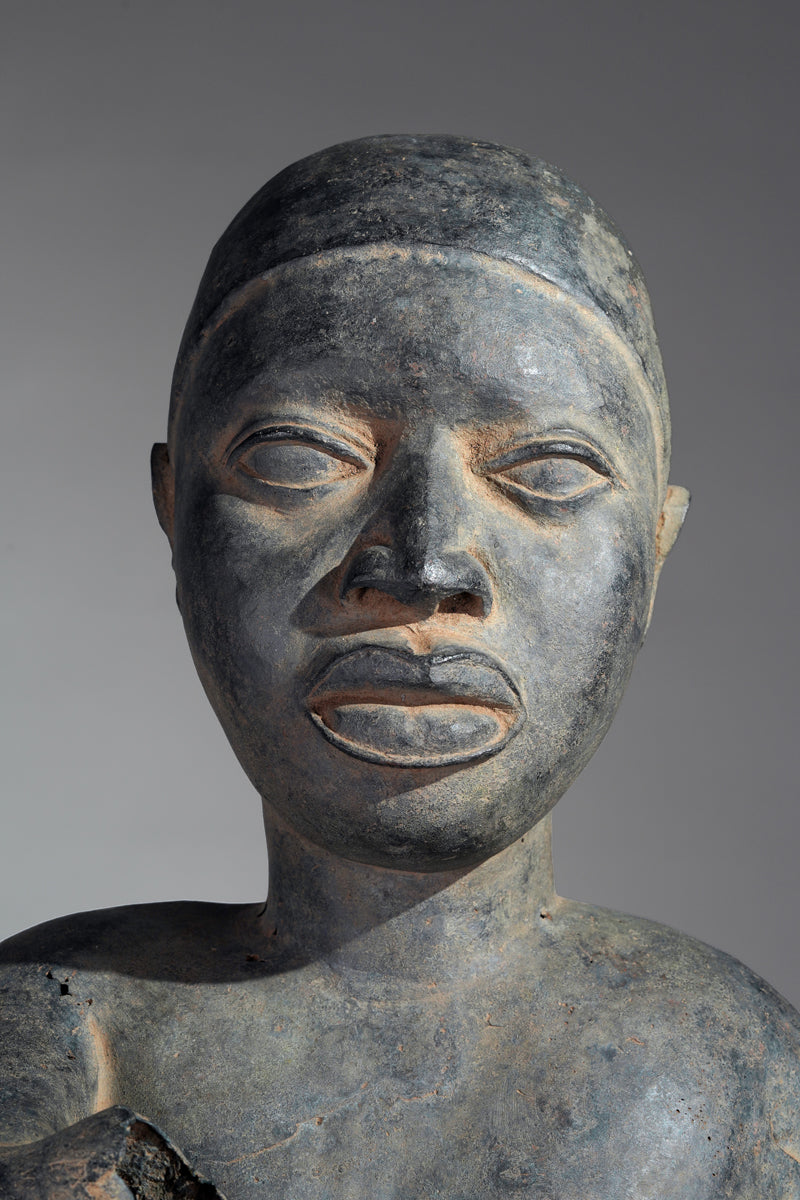
This fragmentary sculpture, originating from the village of Tada, represents one of the earliest known instances of this sculptural type in historical record. The figure is depicted in a seated posture, with one foot resting flat on the ground while the other remains in a kneeling position. The left arm, now partially preserved, supports itself on the upright knee, whereas the right arm survives only in fragmentary form.
Significantly, a hip mask adorns the figure’s right side, suggesting symbolic or ritual significance, possibly related to ancestral or spiritual iconography characteristic of Tada sculptural traditions. The surface exhibits numerous smaller perforations, likely the result of prolonged erosion, though they may originally have functioned as attachment points or decorative elements. The lower torso displays linear scarification patterns, indicative of cultural practices of body marking, which may convey social, religious, or status-related information.
The Tada corpus has been the subject of theoretical reconstruction, most notably in Preston Blier’s model of a “complete sculpture,” wherein the fragmentary elements are hypothesized to belong to a full figurative ensemble, balancing seated and kneeling postures, intricate arm gestures, and complementary adornments. Blier’s analysis emphasizes the interplay of formal symmetry and symbolic decoration, positing that the original sculpture would have presented a harmonized representation of social and ritual ideals.
This piece exemplifies the transitional interplay between localized Tada stylistic conventions and broader regional sculptural motifs. The combination of fragmentary preservation, surface ornamentation, and formal posture provides invaluable insight into both aesthetic priorities and the ceremonial functions of sculptural practice in Tada’s historical context.
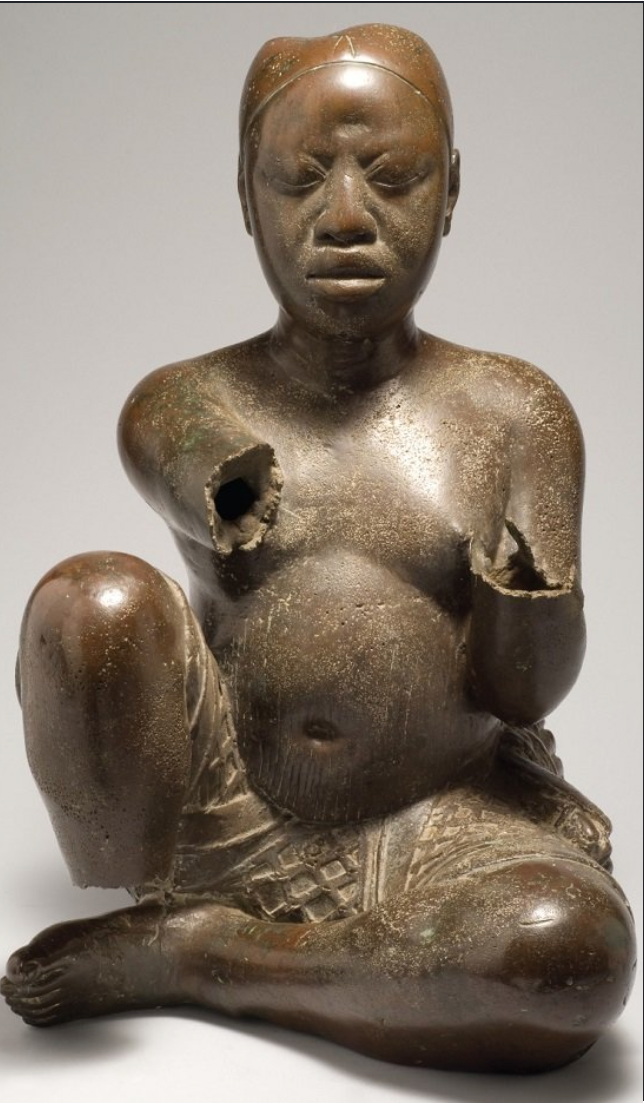
This well known Tada scupture was described:
"The style and the extraordinarily thin casting of this naturalistic figure point to its likely creation at Ife..
Based on this specimen, the question arises as to what this highly fragmentary sculpture looked like in its original state.
Suzanne Preston Blier has addressed this issue.
african arts Winter 2012 vol. 45, no.4, paage 74/ 75
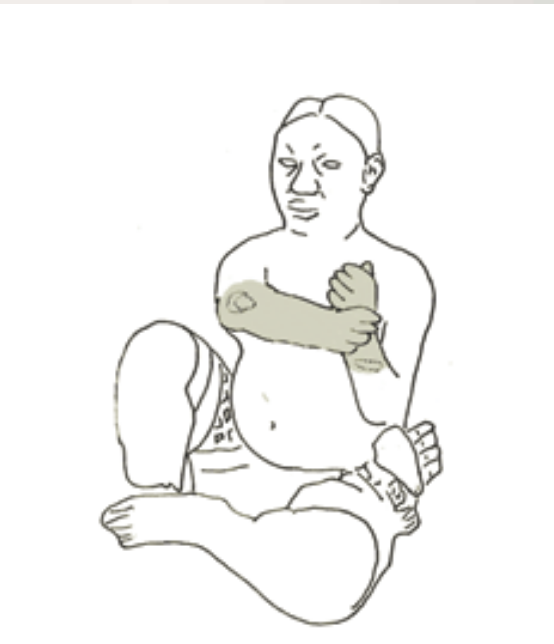
Based on this specimen, the question arises as to what this highly fragmentary sculpture looked like in its original state.
Suzanne Preston Blier has published a drawing that is supposed to depict the presumed original state. Her assumption is based on a comparison of two similar figures from the same find context.
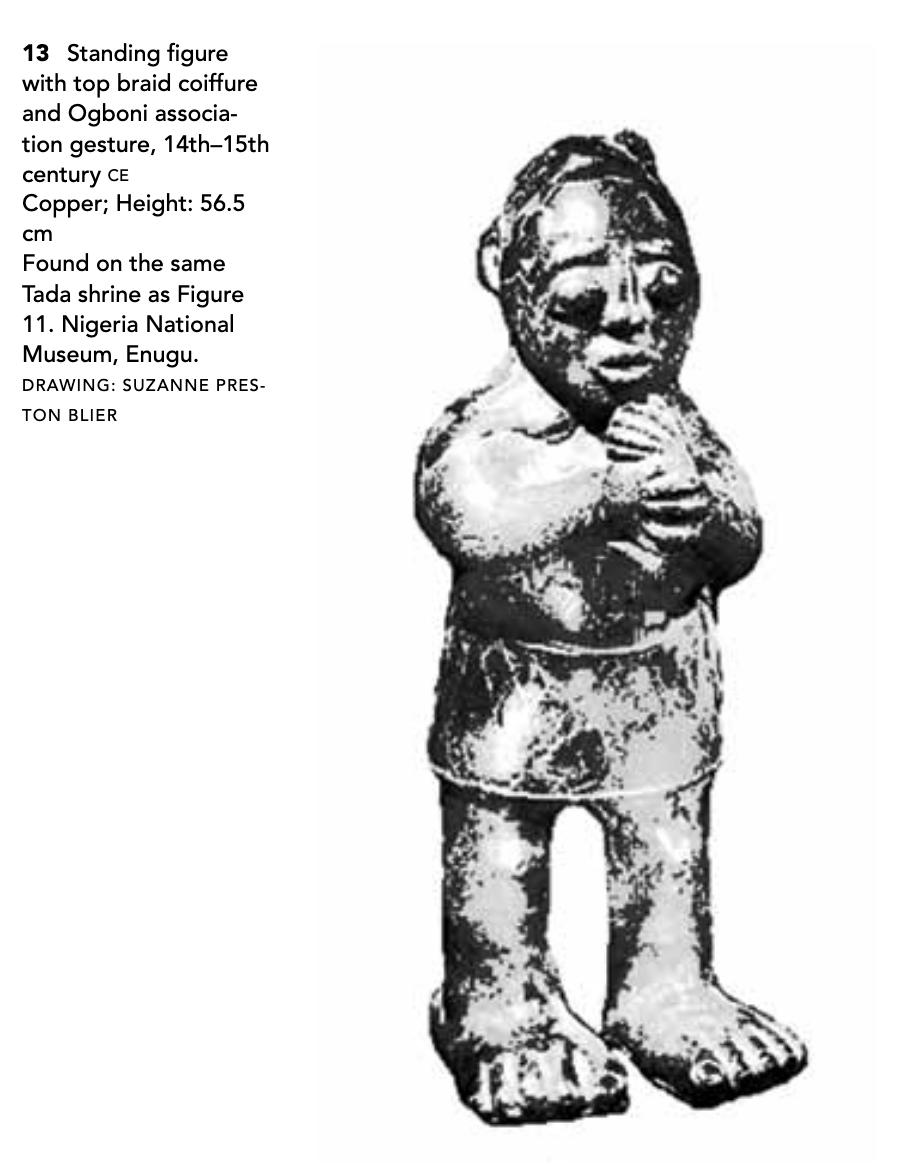
We believe that this assumption does not correspond to reality. Without exception, all specimens of this type show serpent heads in the left hand, which either wind around the corresponding hand at their ends or whose ends are grasped by the right hand.
Occasionally, it is also a cornucopia that is held in the right hand. We have collected centuries of sculptures of this type (based on TL analyses) as well as more recent copies. All these sculptures have the same subject matter. In a letter, Suzanne Preston Blieg pointed out that the examples we have collected may be copies that do not provide evidence of the sculpture's former appearance.
Blier, Suzanne Preston. The History of African Art. London: Thames & Hudson, 2023.
Blier, Suzanne Preston. Art and Risk in Ancient Yoruba: Ife History, Power, and Identity, c. 1300. Cambridge: Cambridge University Press, 2015.
TL Analysis Kotalla, 600 years +/- 15,4 %
CAB38731
Height: 60 cm
Weight: 17,5 kg