

Galerie Wolfgang Jaenicke
Senufo, Déblé (Rhytm Ponder)
Senufo, Déblé (Rhytm Ponder)
Couldn't load pickup availability
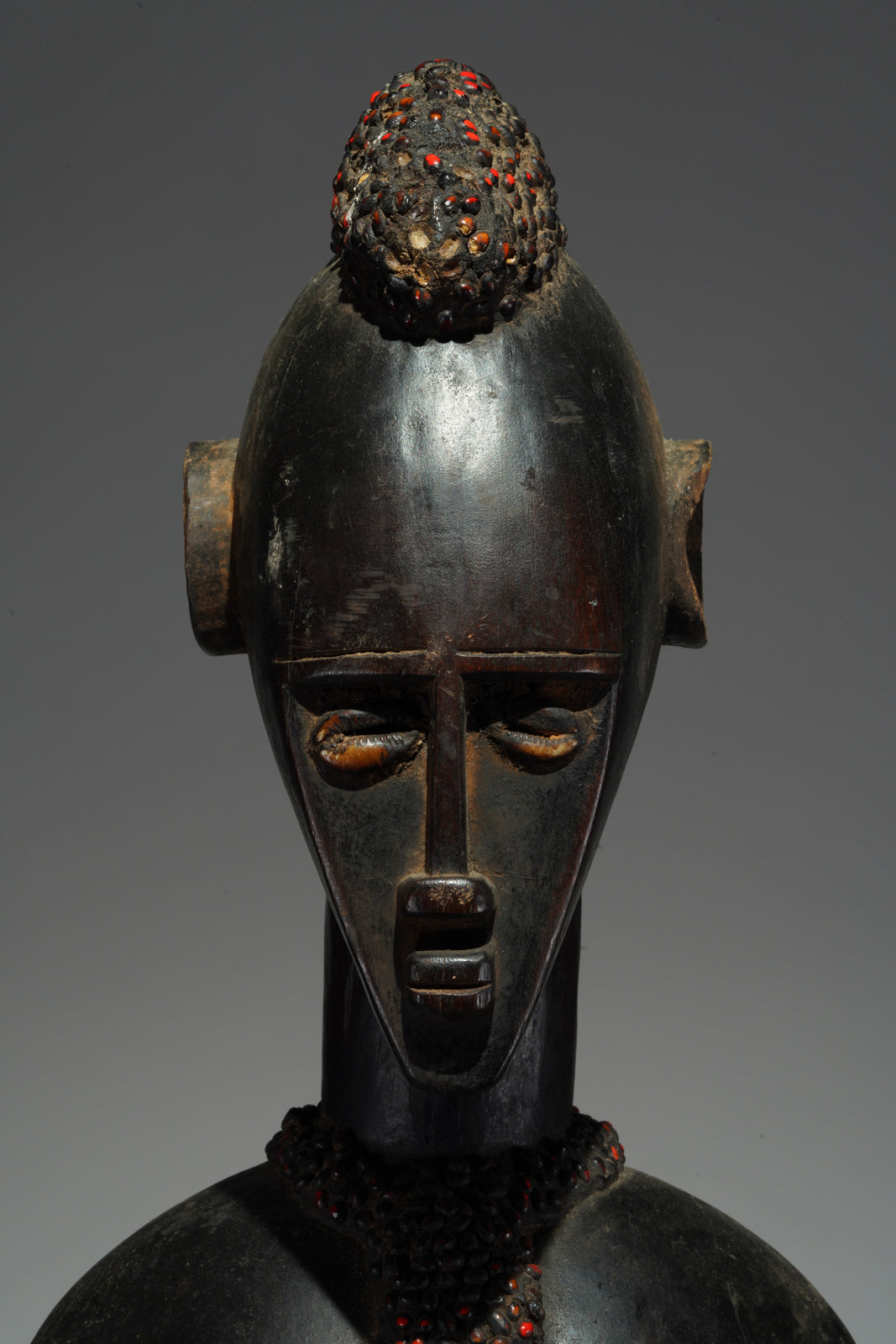
Senufo, Déblé (Rhytm Ponder), Ivory Cost, village of Nafoun, Korhogo Region, Northern Côte d'Ivoire. Wood, black patina, cowrie shells, red seeds.
This female Déblé ranks among the finest known examples of the monumental rhythm pounders created by the Senufo. Déblé were carried beneath the arms by members of the Poro society during funerary ceremonies and other important ritual occasions, where their massive cylindrical bases were rhythmically pounded against the ground. The resulting sound accompanied songs and dances while symbolically linking the community of the living with the ancestors and the earth. Functioning simultaneously as sculptural masterpieces and ritual instruments, Déblé represent one of the most distinctive sculptural traditions of Senufo art.
The present sculpture is distinguished by its remarkable vertical composition and the exceptional harmony of its proportions. A small, slightly forward-inclined head rests upon an unusually elongated cylindrical neck, lending the figure a dignified, almost contemplative presence. The elongated face is dominated by almond-shaped eyes inlaid with cowrie shells, whose half-closed appearance conveys a sense of quiet introspection. The straight nose and slightly parted mouth are reduced to a few essential forms, reinforcing the restrained monumentality of the facial expression. Broad, disc-shaped ears project prominently from either side of the head, creating a striking sculptural counterpoint to the narrow face.
The body follows a clear, almost architectural vertical axis. Gently rounded shoulders lead into a slender, nearly cylindrical torso whose anatomy has been deliberately reduced to its essential forms. Only the finely modelled breasts and delicate linear scarifications on either side of the chest articulate the smooth, polished surface. Exceptionally long arms describe elegant sweeping curves, bringing the hands together in front of the lower abdomen. Their broad palms, with parallel-incised fingers, rest upon the upper thighs and form the compositional centre of the sculpture. Short, powerful legs merge directly into the massive cylindrical base that enabled the figure to function as a rhythm pounder during ritual performances.
Particularly noteworthy is the superbly preserved handling patina on the neck, arms, and hands. The deep black surface, rendered silky and lustrous through decades of repeated contact, provides compelling evidence of prolonged ritual use and constitutes one of the sculpture's most significant historical attributes. The coiffure, adorned with small red seeds, together with matching ornaments around the neck and wrists, introduces subtle accents of colour that enhance the restrained elegance of the composition.
Stylistically, the sculpture bears an exceptionally close relationship to the Déblé illustrated as Figure 5.47 in Senufo Unbound: Dynamics of Art and Identity in West Africa (Cleveland Museum of Art). The two works share not merely the general characteristics of Senufo sculpture but a remarkable series of highly specific formal features: the diminutive head set upon an unusually elongated neck, almost identical body proportions, deeply curving elongated arms, prominent disc-shaped ears, the restrained modelling of the torso, the distinctive treatment of the hands, and an overall sense of quiet monumentality. Above all, the close correspondence in proportions, sculptural rhythm, and compositional balance extends well beyond what might be expected within a broader regional style.
These striking similarities strongly suggest that both sculptures originated within the same workshop tradition centred in the village of Nafoun. It is even conceivable that they were carved by the same sculptor or within the immediate circle of a single master. While such an attribution necessarily remains a stylistic hypothesis in the absence of documentary workshop evidence, it follows the well-established methodology of connoisseurship and workshop attribution that has long been employed in the study of African sculpture.
In this context, it seems appropriate to identify the stylistic group represented by the present sculpture and the example published in Senufo Unbound under the provisional designation "Master of Nafoun", or alternatively, the "Workshop of Figure 5.47." The present Déblé should be regarded as one of the finest works presently attributable to this anonymous master or his workshop. Its origin in the village of Nafoun has been independently confirmed by Belo Garba of Korhogo and Bakari Bouaflé of Abidjan. This rare convergence of local oral tradition and stylistic analysis considerably strengthens the proposed attribution and establishes the sculpture as an important reference work for the future study of regional carving ateliers among the Senufo.
Comparative Literature
McNaughton, Patrick R. (ed.), Senufo Unbound: Dynamics of Art and Identity in West Africa, Cleveland Museum of Art, Cleveland, 2024, fig. 5.47.
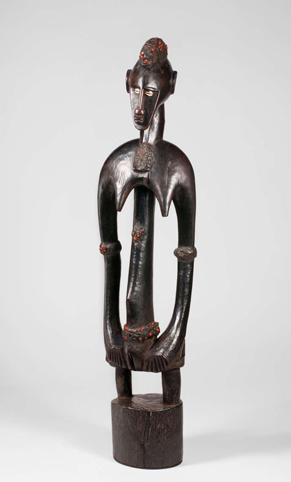
Source: Susan Elisabeth Gagliardi,Cleveland Museum, Ohio, USA.Senufo Unbound, plate 46/47 (mostly wellknown is the "Western Provenance" ,in the description we read "unknown artist".Perhaps one could say that this is a postcolonial, Western view of Africa, because the makers of these sculptures do not see themselves as "artists" in Africa. They are craftsmen, often blacksmiths, who, despite being integrated into village communities, usually live on the outskirts of the villages. Learning where these villages are and how the carvers influenced each other might say more about Africa than a "family tree" of Western owners. But that would mean that anthropologists do field research in Africa instead of running museums that are under the influence of the art trade.
Lit.: A lecture of Dr. Junker, "der Originalzustand.. Wo ist er geblieben?" Gottschalk Burkhard, "Senufo, Massa und die Statuen des poro" 2002: 43; Glaze Anita J., "Art and Death in a Senufo Village", Indiana University Press, Bloomington 1981. A related eyemplare: Robert Goldwater, Senufo Sculpture from West Africa, New York, 1964, ills. 88 and 88a, Werner Gillon, Collecting African Art, London, 1979, p. 50, fig. 38 William Rubin, "Primitivism" in 20th Century Art: Affinity of the Tribal and the Modern, New York, 1984, vol. 1, p. 131 William Rubin, Le Primitivisme dans l’art du 20e siècle. Les artistes modernes devant l’art tribal, Paris, 1987, p. 131 Jacques Kerchache, Jean-Louis Paudrat and Lucien Stéphan, L'art africain, Paris, 1988, p. 82, pl. 34, Jacques Kerchache, Jean-Louis Paudrat, and Lucien Stéphan (eds.), Die Kunst des Schwarzen Afrika, Freiburg, 1989, p. 80, pl. 34 Jacques Kerchache, Jean-Louis Paudrat and Lucien Stéphan, Art of Africa, New York, 1993, p. 82, pl. 34 Mary H. Nooter, Secrecy: African Art that Conceals and Reveals, New York, 1993, p. 155, cat. 79.
Informant: Belo Garba et Bakari Bouaflé
Inv. No. MAZ18531
Height: 119 cm
Weight: 13 kg