

Galerie Wolfgang Jaenicke
Prampram statue
Prampram statue
Couldn't load pickup availability
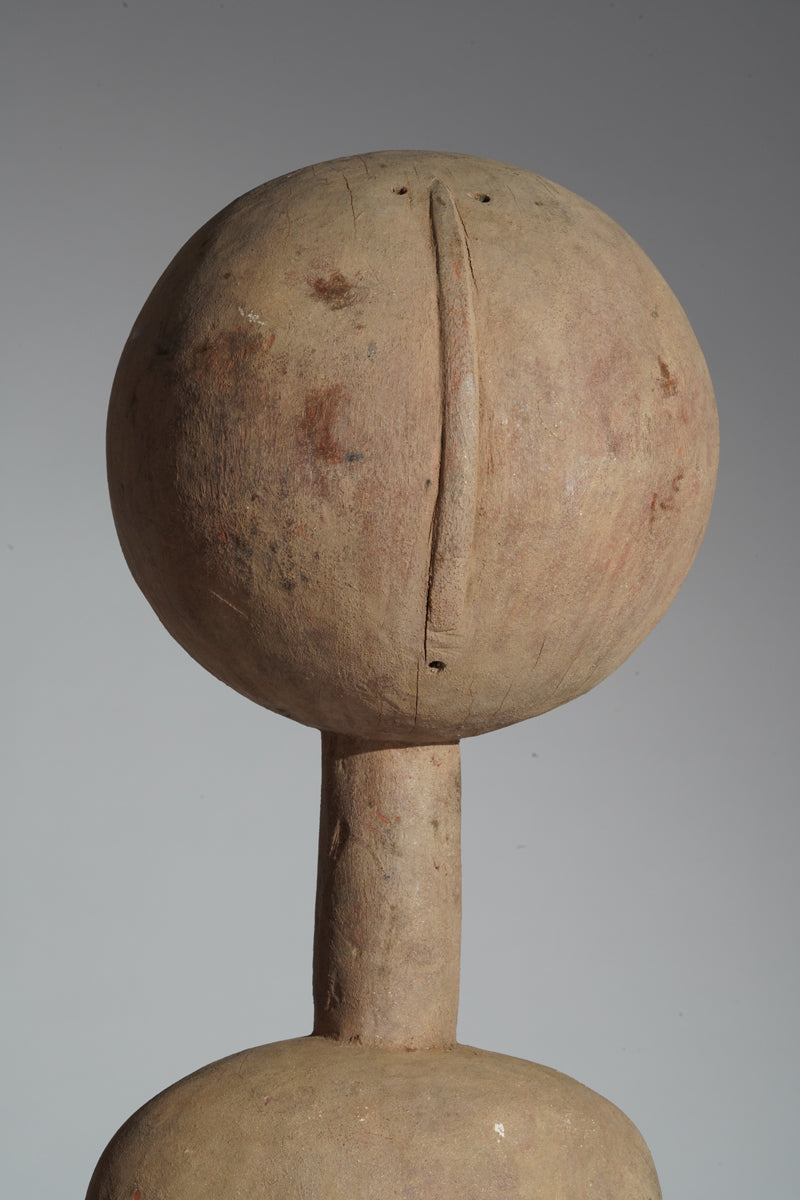
This Prampram statue, associated with the coastal town of Prampram in southern Ghana, must be understood within a historical and ritual environment shaped by maritime exchange, regional mobility, and layered religious practice. The coastal belt of southeastern Ghana has long been a zone of encounter, where Ga-Adangbe-speaking communities engaged with trans-Atlantic trade networks and, from the early modern period onward, with European commercial and missionary presences. Within this context, sculptural production does not adhere to a rigidly bounded stylistic canon but instead reflects adaptive, situational responses to changing social and spiritual demands.
The Statue Prampram likely functioned as part of a shrine assemblage, serving as a material interface between human actors and a range of spiritual entities that structure local cosmology. Such figures are not autonomous artworks but relational objects, activated through libation, invocation, and the periodic renewal of offerings. Their efficacy resides less in their visual form than in their capacity to host, channel, or stabilize spiritual presence. In this sense, the sculpture participates in a broader ontology in which matter is not inert but responsive, capable of transformation through ritual practice.
Formally, sculptures from the Prampram area often retain a recognizable anthropomorphic structure, distinguishing them from more abstract or heavily accreted ritual forms found elsewhere in West Africa. This relative clarity of form may facilitate identification, allowing practitioners to associate the figure with a specific deity, ancestor, or tutelary force. At the same time, such legibility should not be conflated with naturalism in a Western sense; proportions, gestures, and surface treatments are shaped by symbolic and functional considerations that exceed purely aesthetic concerns. The carving may emphasize particular bodily features understood to be loci of power or perception, thereby structuring the ways in which the figure engages with its ritual environment.
Materially, the statue is most likely carved in wood, a medium widely used in southern Ghana for both sacred and secular purposes. The surface may bear traces of pigments, oils, or other substances applied during ritual use, though these treatments typically do not accumulate into the dense encrustations characteristic of certain inland traditions. Instead, maintenance practices often involve cleaning, repainting, or otherwise renewing the figure, suggesting a cyclical rather than accumulative approach to material transformation. This distinction points to differing conceptions of how spiritual potency is sustained: not through visible layering, but through repeated acts of care and activation.
The religious landscape in which this sculpture operated has been marked by sustained pluralism. Indigenous belief systems centered on deities, ancestral forces, and localized spirits have long coexisted with Christianity and Islam, particularly since the nineteenth century. In coastal regions such as Prampram, where missionary activity was especially pronounced, shrine practices have undergone processes of adaptation, concealment, or reinterpretation. The statue thus may bear witness to these historical dynamics, embodying a continuity of practice that persists alongside, and sometimes in tension with, introduced religious frameworks.
Attention to the coastal setting further enriches interpretation. The proximity to the Atlantic Ocean situates the sculpture within a cosmology in which the sea is both a material resource and a domain of spiritual significance. Deities associated with water, fishing, and protection from maritime danger occupy an important place in local practice, and sculptural forms may serve as points of mediation in these relationships. The statue can therefore be read not only as a representation or embodiment of a spiritual entity, but also as part of an ecological and economic system in which human survival is closely tied to the rhythms and uncertainties of the समुद.
When displaced into museum collections, objects of this kind are often recontextualized as examples of “African art,” a categorization that foregrounds formal qualities while obscuring original functions. Such reclassification entails a shift from performative engagement to visual contemplation, altering the conditions under which the object is encountered and understood. Yet even in such settings, the material traces of use—wear patterns, residues, repairs—retain evidentiary value, pointing back to the sculpture’s embeddedness in lived practice.
This Prampram statue thus resists reduction to a purely aesthetic artifact. It is better approached as a node within a شبكة of relationships linking human communities, spiritual forces, and a historically contingent environment. Its form, material, and condition encode not only artistic decisions but also the cumulative effects of ritual action, social change, and regional interaction. To engage it critically requires an interpretive framework attentive to process, context, and the limits of translation across cultural epistemologies.
References
Jaenicke-Njoya Archive CAB47773
Cole, Herbert M., and Doran H. Ross. The Arts of Ghana. University of California Press, 1977.
Blier, Suzanne Preston. African Vodun: Art, Psychology, and Power. University of Chicago Press, 1995.
Meyer, Birgit. Translating the Devil: Religion and Modernity Among the Ewe in Ghana. Edinburgh University Press, 1999.
Ross, Doran H. Wrapped in Pride: Ghanaian Kente and African American Identity. UCLA Fowler Museum of Cultural History, 1998.
Quarcoopome, Nii O. Through African Eyes: The European in African Art, 1500 to Present. Detroit Institute of Arts, 2010.
This description is made with AI. Despite careful individual review, the use of Artificial Intelligence may result in errors or inaccuracies in the description.
Height: 111 cm / 107 cm
Weight: 6 kg / 5,4 kg