

Galerie Wolfgang Jaenicke
Prampram couple statue
Prampram couple statue
Couldn't load pickup availability
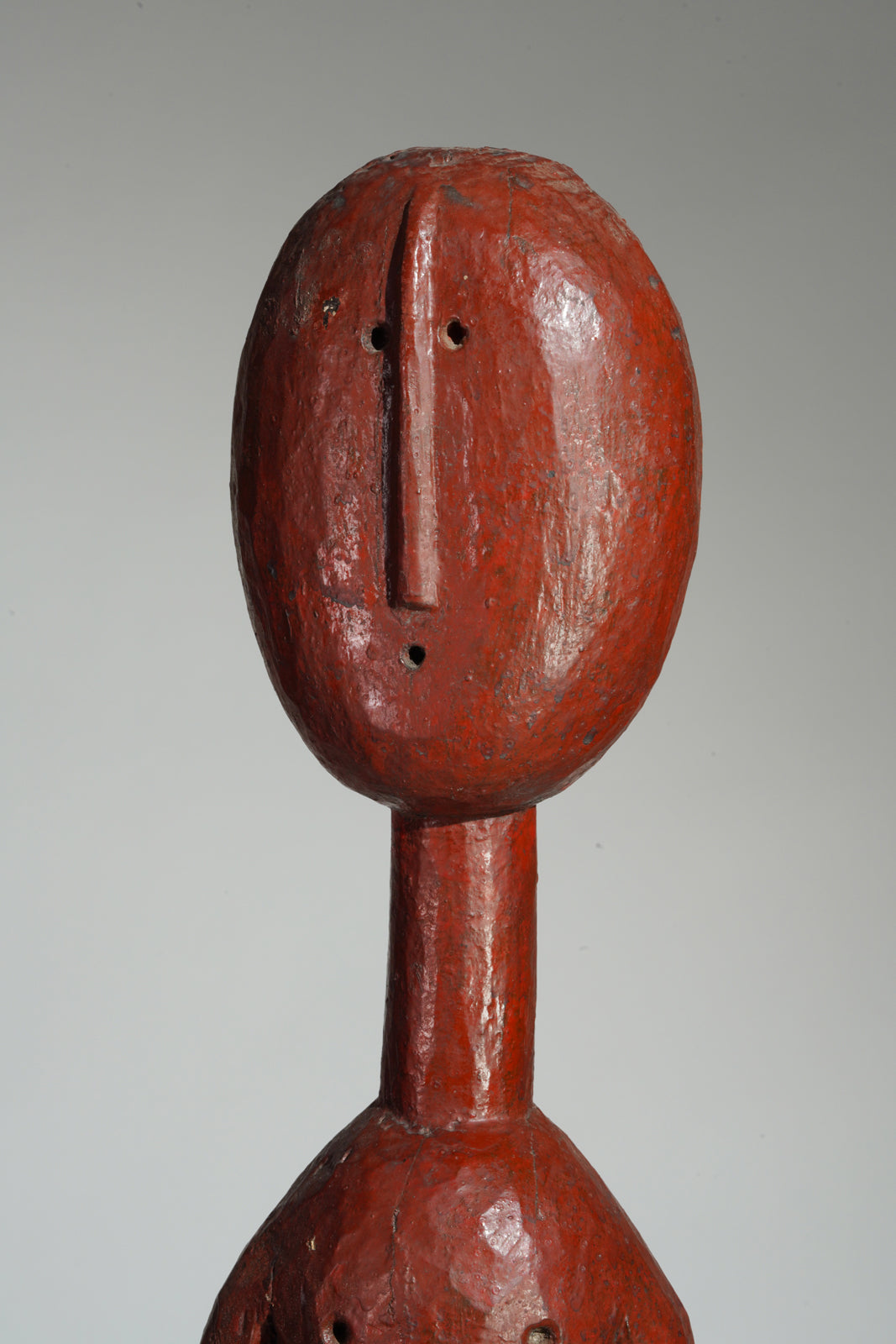
Prampram couple statue, Prampram region, Old Ningo village, Ghana.
Both figures have extremely elongated and graceful bodies. The straight torso extends cylindrically before dividing into tapered legs without feet. The arms hang down along the torso, closely following the body's lines. They taper gradually and end abruptly, without any demarcation for the hands. A long, cylindrical neck supports an ovoid or spherical head. The face is rendered with remarkable economy of means: the eyes and mouth are represented by small, indented circular perforations, while the nose is simply a thin vertical ridge. A vertical line of identical circular holes runs across the entire central axis of the torso and abdomen, evoking ritual scarification patterns or clan marks, traces of cracks on the face and certain parts of the body. Carved from wood, the pieces have a smooth patina entirely covered with a uniform red or reddish-brown pigment, a color frequently associated with blood, transition and life force in the rituals of this region.
The PramPram figures belong to a locally confined and comparatively poorly documented artistic tradition within the Ga Dangme cultures of the southeastern coast of Ghana. Their stylistic distinctiveness is often linked to influences from neighboring regions—especially northern Ghana and Togo—suggesting historical mobility of artists and cultural exchange.
Pair figures occupy a special position within this tradition. They are understood as complementary units and are presumably connected to local shrine practices, ancestor worship, or protective rituals. Their function is not entirely clear, but existing evidence suggests that they were placed in domestic or communal contexts and acted as intermediaries between the living and the ancestors.
Furthermore, such figures can be interpreted as material manifestations of social order: The pairing reflects fundamental concepts of duality—such as male/female, active/passive, or visible/invisible—and translates these into a sculptural form. The use of color reinforces this symbolic level by not only making the figures visible but also marking them as carriers of ritual energy.
Literature (selection)
Cole, Herbert M.; Ross, Doran H.: The Arts of Ghana. Los Angeles 1977.
Arhin, Kwame: “The Political and Cultural History of the Ga People”, in: Transactions of the Historical Society of Ghana, 1974.
Nooter, Mary H.; Roberts, Allen F.: Memory: Luba Art and the Making of History. New York 1996.
Dogbe, B. K.: “The Human Form as a Central Theme in Art”, in: Image (Journal of the College of Art), Kumasi 1977.
This information is created by AI and based on published ethnographic and art-historical sources.
Jaenicke–Njoya Archive MAZ11376
Height: 114 cm / 113 cm
Weight: 4,6 kg / 3,8 kg (incl. stand)