

Galerie Wolfgang Jaenicke
Nok sculpture
Nok sculpture
Couldn't load pickup availability
Nok Culture, Kaduna Region, Nigeria
Seated Anthropomorphic Figure
Terracotta
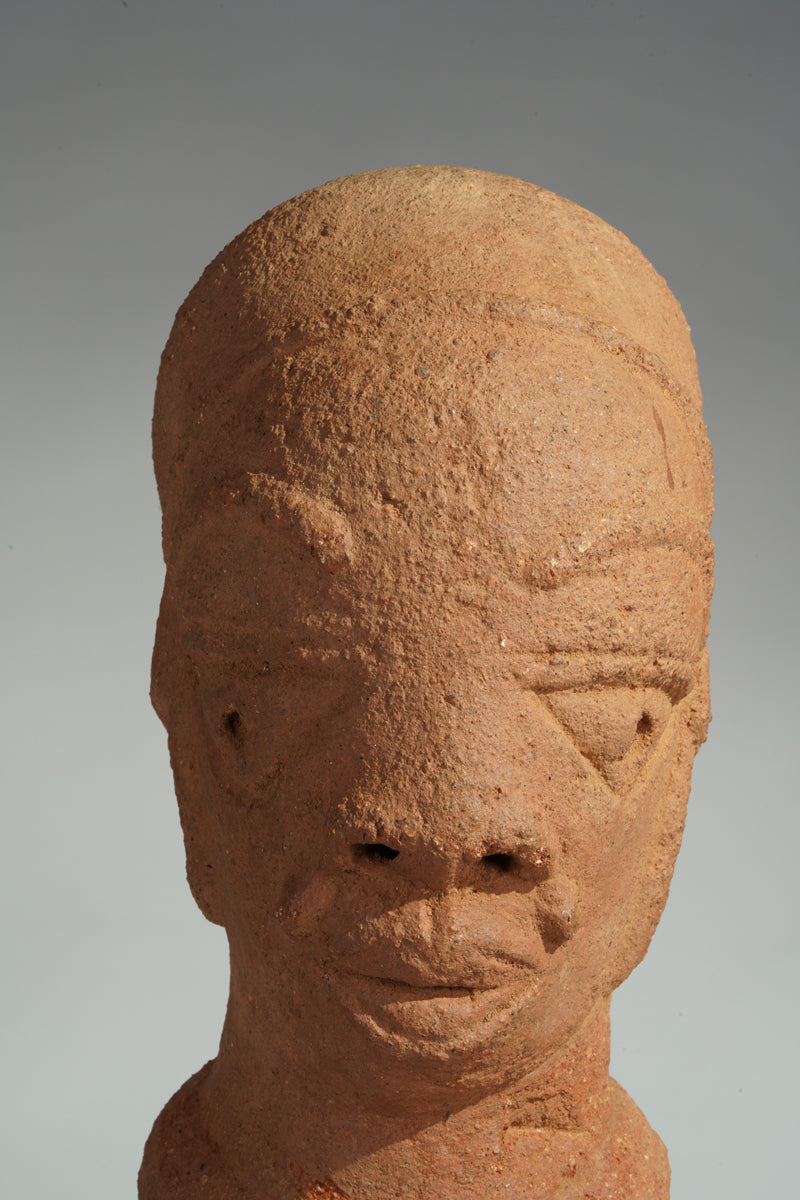
This strongly modelled terracotta figure can be situated convincingly within the broader sculptural tradition associated with the Nok cultural complex of central Nigeria, assuming that the attribution to the Kaduna region is supported by its provenance. Within the considerable formal diversity of Nok sculpture, the work appears to belong to a comparatively compact and volumetric group of seated or crouching figures rather than to the more elaborately ornamented and finely articulated types. A precise chronological attribution, however, should not be made on stylistic grounds alone and would require consideration of provenance, archaeological context where available, and thermoluminescence analysis.
The figure is represented in an unusually dynamic seated or crouching posture. The body rises from an approximately cylindrical base that widens slightly towards the bottom. One leg is sharply flexed and drawn high in front of the torso, the foot prominently positioned above the base, while the second leg is placed considerably lower and partially absorbed into the overall sculptural mass. This asymmetrical arrangement introduces a pronounced diagonal movement that counterbalances the otherwise strongly vertical disposition of the figure.
Particularly striking is the relationship between head and body. The disproportionately large, almost spherical head rests upon a relatively long and narrow neck. The facial features are strongly abstracted and geometrically organized. Large almond- to triangular-shaped eyes contain pierced pupils; pronounced upper lids and arched brows dominate the upper part of the face, while a short, broad nose with open nostrils and a small, plastically modelled mouth occupy the lower register. This geometric organization of the face, and particularly the characteristic treatment of the eyes and pupils, belongs to the most recognizable elements of the Nok sculptural vocabulary.
The treatment of the coiffure or head covering is notably restrained when compared with the elaborate hairstyles encountered on many Nok heads. A narrow raised band extends across the forehead and towards the temples, separating the broad, smoothly rounded cranial volume from the face. Elongated, vertically articulated elements beside the head may represent stylized locks of hair, ornaments, or components of a headdress. Their relative simplicity contributes to the monumental coherence of the head rather than interrupting it with extensive surface decoration.
A broad, rounded collar or series of neck ornaments encircles the base of the neck, while several horizontal bands articulate the waist. The arms are arranged asymmetrically. One hand projects laterally beside the body, whereas the opposite arm remains more closely integrated with the torso. The hands themselves are schematically rendered, with parallel incisions indicating the fingers. The economy with which such anatomical details are treated is consistent with the broader tendency of the sculpture to subordinate detail to the organization of large volumes.
The combination of a dominant head, geometrically constructed eyes, pierced pupils, open nostrils, abstracted facial features, neck ornament and strongly articulated seated posture situates the figure within the established formal repertoire of Nok terracotta sculpture. At the same time, Nok sculpture should not be understood as conforming to a single rigid stylistic canon. Archaeological research has demonstrated considerable variation in scale, modelling, ornament and figural conception across the Nok cultural area.
The posture is particularly significant in this respect. Standing, kneeling and seated figures all occur within the known Nok corpus, including compositions in which one knee is raised prominently towards the torso. The present figure therefore represents an established possibility within Nok figural sculpture rather than an iconographic anomaly. The elevated leg is especially important to the composition, creating a visual relationship between the lower body, the hands and the upright torso.
The sculpture nevertheless differs markedly from the more elaborately conceived figures traditionally associated with the Katsina-Ala area, which may display complex coiffures, extensive beadwork and jewellery, and a more finely differentiated treatment of the body. Here ornament is comparatively restrained and the modelling considerably more compact. The sculptor instead constructs the figure through a succession of powerful, relatively autonomous volumes: the spherical head, elongated neck, upright torso, sharply raised leg and cylindrical base. Seen in profile, this conception becomes particularly evident. The rounded mass of the cranium, the near-vertical body and the diagonal projection of the raised leg establish a carefully balanced sequence of forms. This volumetric organization is among the sculpture's most compelling formal qualities.
Any more specific iconographic interpretation should remain cautious. Neither the sex nor the social or ritual identity of the figure can be established securely from its appearance alone. The posture should therefore not automatically be interpreted as that of a ruler, priest, dignitary or so-called thinker. Although archaeological investigations have provided increasing evidence for the deliberate fragmentation and deposition of Nok terracottas, suggesting that sculpture participated in ritual or socially significant practices, the precise function and meaning of individual figures remain uncertain.
The modelling around the raised leg and the opposite hand is also noteworthy. From the photographs alone it is difficult to determine whether these forms are entirely anatomical or whether the figure was conceived in relation to an attribute. In the absence of further evidence, it is preferable to retain a descriptive interpretation rather than assign a specific iconographic meaning.
Chronologically, caution is equally appropriate. The conventional designation of Nok sculpture as approximately 500 BCE–200 CE remains widespread, but archaeological research over recent decades has produced a considerably more differentiated chronology for the Nok cultural phenomenon. For an object without a documented archaeological context, a broader attribution to the Nok cultural complex, first millennium BCE–first millennium CE may therefore be preferable unless thermoluminescence results or securely documented provenance support a narrower date.
Selected Literature
Bernard Fagg, Nok Terracottas, London and Lagos, 1990.
Joseph F. Jemkur, Aspects of the Nok Culture, Zaria, 1992.
Angela Fagg, “Thoughts on Nok,” African Arts, vol. 27, no. 3, 1994, pp. 79–83, 103.
Bernard de Grunne, The Birth of Art in Africa: Nok Statuary in Nigeria, Paris, 1998.
Claire Boullier and Alain Person, “Male Statuary of Nok: An Iconography of Seated Male Figures,” Tribal Arts, no. 21, 1999, pp. 98–113.
Nicole Rupp, James Ameje and Peter Breunig, “New Studies on the Nok Culture of Central Nigeria,” Journal of African Archaeology, vol. 3, no. 2, 2005, pp. 283–290.
Peter Breunig, ed., Nok: African Sculpture in Archaeological Context, Frankfurt am Main, 2014.
Peter Breunig and Nicole Rupp, “An Outline of Recent Studies on the Nigerian Nok Culture,” Journal of African Archaeology, vol. 14, no. 3, 2016, pp. 237–255.
Gabriele Franke, “A Chronology of the Central Nigerian Nok Culture – 1500 BC to the Beginning of the Common Era,” Journal of African Archaeology, vol. 14, no. 3, 2016, pp. 257–289.
Tanja M. Männel and Peter Breunig, “The Nok Terracotta Sculptures of Pangwari,” Journal of African Archaeology, vol. 14, no. 3, 2016, pp. 313–329.
Some of the information is generated by artificial intelligence and is based on published sources from the fields of ethnography, archaeology, and art history.
Inv. No. MAZ26990
Height: 57 cm
Weight: 7 kg