

Galerie Wolfgang Jaenicke
Lobi sculpture
Lobi sculpture
Couldn't load pickup availability
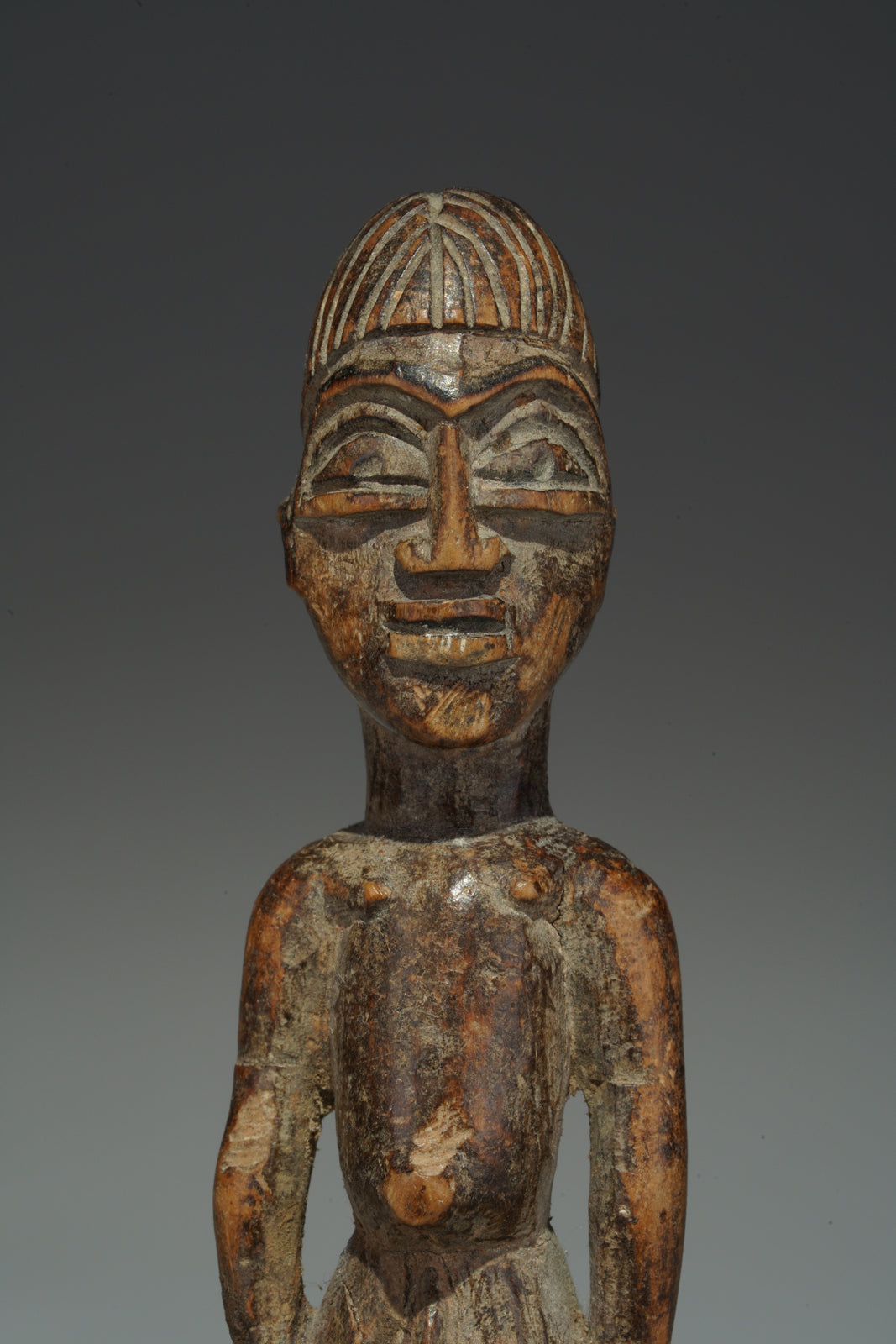
Lobi sculpture, Loropeni region, Burkina Faso. incl stand.
This wooden male figure is distinguished by its very slender silhouette, constructed with strict frontality: the ovoid head, disproportionately large compared to the body, rests on a long, cylindrical neck, while the angular shoulders, narrow torso, and parallel legs create an almost hieratic vertical structure. The face, rendered with great economy of means, features half-closed almond-shaped eyes, a straight nose, a mouth with overlapping lips, and large, geometrically shaped ears; the smooth skullcap is separated from the forehead by a curved incision. The arms, held close to the body, converge towards the pubic region, where the male genitalia and navel are clearly indicated. A reddish-ochre substance largely covers the surface, now matte, abraded, and cracked; a significant longitudinal fissure runs through the head and torso, while the ends of the legs are deeply damaged, probably by moisture and wood-boring insects. Within the framework of a Lobi attribution, this sculpture can be compared to the figures called bateba, placed in domestic sanctuaries dedicated to the protective powers associated with families and territory: conceived as auxiliaries of the spirits, they could receive libations or offerings intended to maintain their benevolence.
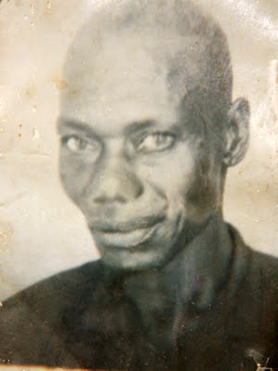
Pessare Dah, 1949 - 1995
Pessare Dah was a Lobi sculptor from Burkina Faso whose legacy has only recently been recognized and studied in detail. Born in 1949 in the village of Gongonbili, he spent most of his working life in Tankoura near Loropeni. Although his name was unknown to the art world for many years, his distinct sculptural style gained scholarly attention following research efforts that began around 2010. Dah is now considered one of the few Lobi artists whose work can be clearly attributed by name, joining the ranks of other notable carvers such as Sikire Kambire.
Dah’s early work was deeply influenced by Sikire Kambire, an earlier master sculptor whose death in 1963 marked the end of an era in Lobi art. Sikire’s figures, often characterized by hollowed or burned-out eyes and deep facial grooves, served as a model for Dah’s initial carvings. These formal similarities were noted in both the carving techniques and the visual language that defined the figures’ emotional intensity. Over time, however, Dah’s work evolved into something more individualistic. Scholars such as Wolfgang Jaenicke have identified three stylistic phases in Dah’s career, moving from direct imitation to a middle phase of experimentation, and ultimately to a late period marked by greater formal freedom and expressiveness (Jaenicke, 2020).
Pessare Dah’s sculptures were primarily made of Sankolo wood, a dense and enduring material that contributed to the statues’ gravity and physical presence. Among his best-known works are representations of male and female ancestral couples, which play a central role in Lobi religious and social life. These figures were typically used in ritual contexts to mediate between the human and spiritual worlds. However, there is also evidence that Dah created works for commercial sale. Some of his later pieces, including small four-legged stools and less ritually specific figures, seem to have been designed with Western collectors in mind (Howlett, Nocetti & Keller, 2014).
This dual role—as a ritual artist and a craftsman engaging with a growing global market—positions Dah as a transitional figure in Lobi art. His works occupy a space between tradition and innovation, between local spiritual meaning and external aesthetic demand. Though he passed away in 1995, Dah’s work continues to be reassessed by scholars, collectors, and curators. The relatively recent identification of his style and authorship has not only deepened our understanding of Lobi sculpture but also raised questions about the broader dynamics of authorship, authenticity, and cultural exchange in African art.
Sources
– Wolfgang Jaenicke, “Pessara Dah: Ein Lobi-Künstler wird wiederentdeckt,” wolfgang-jaenicke.blogspot.com, 2020.
– Paul Howlett, William Nocetti, Thomas Keller, “Statuary in Context: Understanding Pessare Dah,” statuary-in-context.blogspot.com, 2014.
– Jaenicke, Wolfgang. The Forgotten Masters: Lobi Artists of Burkina Faso, Jaenicke Njoya Publications, 2022.
Selected Literature
Meyer, Piet & Verrips, Jojada. Lobi: West African Sculptures from Burkina Faso. Munich, 2001.
Père, Madeleine. Lobi Statuary. Milan, 2002.
Roy, Christopher D. Land of the Flying Masks: Art and Culture in Burkina Faso. Munich, 2007.
Fischer, Eberhard & Homberger, Lorenz. Afrikanische Meisterwerke. Munich, 1985.
Selected Regional References
Meyer, Piet & Verrips, Jojada. Discussion of the Loroponi sculptural tradition and the work of individual Lobi master sculptors, including Pessare Dah.
Roy, Christopher D. Comparative analysis of regional Lobi carving styles, shrine figures and the artistic traditions of the Loroponi region.
Some of the information is generated by artificial intelligence and is based on published sources from the fields of ethnography, archaeology, and art history.
Invt. No. MAZ20475
Height: 16 cm
Weight: 80 g (incl. stand)