

Galerie Wolfgang Jaenicke
Lobi carver Bimtiote Dah
Lobi carver Bimtiote Dah
Couldn't load pickup availability
Among the relatively small number of named sculptors identified within the vast field of West African so-called “tribal” sculpture, the Lobi carver Bimtiote Dah occupies a singular and still insufficiently studied position. His name emerged gradually through a convergence of field inquiry, stylistic observation, oral testimony, and the growing awareness among collectors and researchers that certain Lobi sculptures displayed a coherence of form too distinctive to be explained merely through anonymous village production. In a corpus traditionally approached through ethnic categories rather than individual authorship, the attribution of works to Bimtiote Dah represented a subtle but important shift toward the recognition of artistic personality within Lobi sculpture.
The discovery of the sculptor’s identity is closely connected with the field investigations and archival efforts of collectors and researchers working in the Lobi regions of Burkina Faso and northern Côte d’Ivoire during the late twentieth and early twenty-first centuries. The name itself surfaced through oral testimony preserved by local informants, most importantly Binate Kambou, who played a decisive role in identifying workshops, tracing stylistic lineages, and preserving memories of sculptors whose names would otherwise likely have disappeared. Kambou belonged to that diminishing generation of local mediators whose knowledge bridged ritual practice, village history, and the expanding international interest in African sculpture. His testimony linked a number of highly characteristic bateba figures to a sculptor originating from the vicinity of Bouna and active near Sansana south of Gaoua. (jaenicke-njoya.com)
According to these accounts, Bimtiote Dah appears to have lived approximately between the 1920s and the early 1990s. He worked in a region historically marked by movement across present-day borders between Burkina Faso and Côte d’Ivoire, a frontier zone in which Lobi, Dagara, Birifor, and related communities maintained fluid cultural exchanges. The sculptor’s workshop is said to have enjoyed considerable local renown during his lifetime, although this fame remained largely invisible to the outside world. Unlike court artists in centralized African kingdoms, Lobi sculptors generally operated within decentralized ritual systems. Their sculptures were not conceived as autonomous art objects but as spiritually charged presences commissioned through divinatory instruction and embedded within the architecture of household shrines.
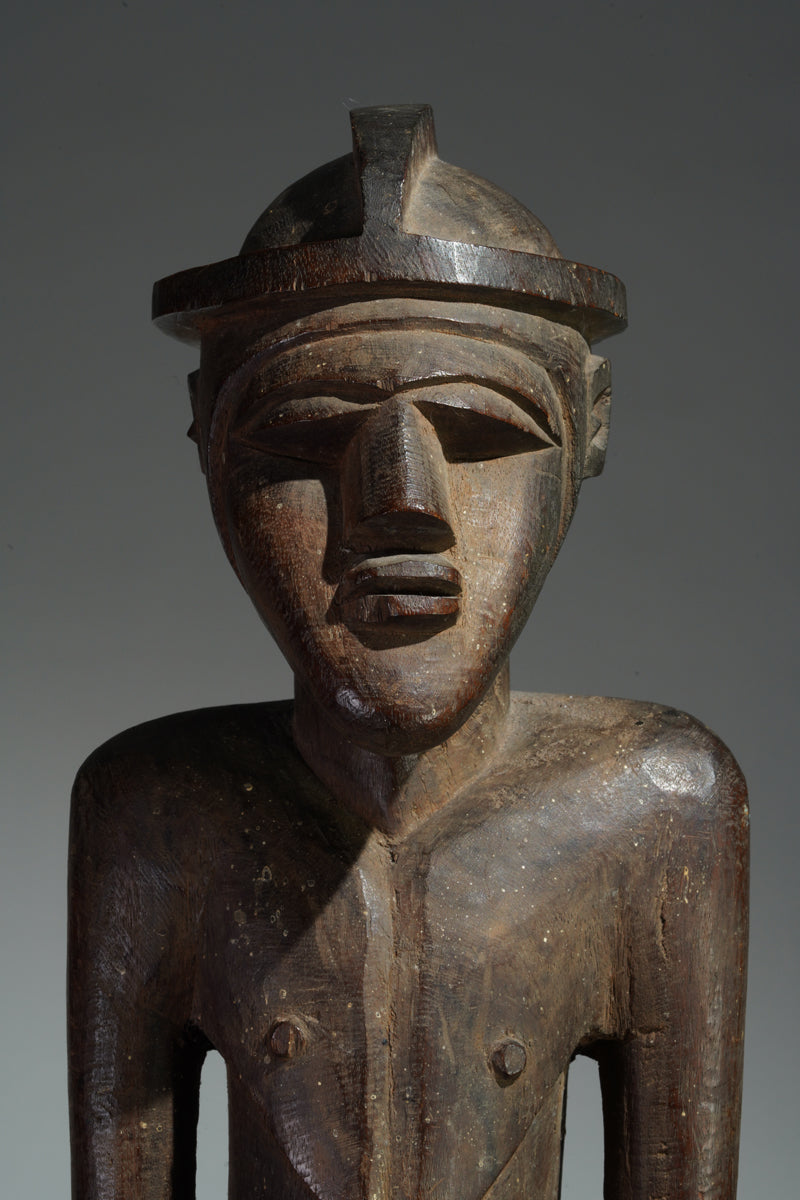
The recognition of Bimtiote Dah as an identifiable artistic hand emerged retrospectively through stylistic comparison. Certain sculptures associated with him display a striking formal consistency: elongated torsos, tense frontal compositions, compact heads, restrained facial definition, and a curious balance between monumentality and instability. Many works attributed to him possess subtle asymmetries and structural tensions that distinguish them from more formulaic workshop production. These qualities led some observers to speak of a distinctive “Bimtiote Dah style,” although such terminology remains necessarily provisional in the absence of signed works or extensive documentary evidence.
The discussion surrounding his oeuvre gained wider visibility through posts and exchanges published on the Blogspot platform associated with Paul Howlett and related tribal art forums, where debates concerning attribution, workshop identities, and “master hands” in African sculpture became increasingly prominent during the early 2000s. These online discussions formed part of a broader transformation in the discourse of African art, moving away from purely ethnic classifications toward more nuanced considerations of regional ateliers and individual sculptural personalities. The case of Bimtiote Dah became especially compelling because it rested not solely upon connoisseurship in the Western sense, but upon local oral confirmation transmitted through figures such as Binate Kambou and later reportedly corroborated by the sculptor’s son, himself active as a ritual specialist near Sansana. (jaenicke-njoya.com)
What makes this history particularly revealing is the fragile nature of such discoveries. Knowledge about sculptors in Lobi society was never systematically archived. Names circulated orally, often within restricted ritual contexts, and many disappeared within a single generation. The rediscovery of Bimtiote Dah therefore illuminates not only one sculptor but also the conditions under which African artistic authorship survives or vanishes. It demonstrates how attribution in African art often depends upon precarious chains of memory involving interpreters, traders, ritual specialists, descendants, collectors, and field researchers.
At the same time, the figure of Binate Kambou occupies an ambiguous and historically fascinating position within this process. Informants of his type were indispensable for the reconstruction of local artistic histories, yet they also operated within economies shaped by tourism, collecting, and the international art market. As later discussions concerning authenticity and workshop production in the Lobi region suggest, the boundaries between documentation, interpretation, reconstruction, and commercial mediation were not always entirely stable. Nevertheless, without such intermediaries, the name of Bimtiote Dah would almost certainly have remained unknown outside his immediate region. (Revue des Arts et Sciences Sociales)
The attribution of sculptures to Bimtiote Dah also intersects with a larger historiographic question concerning individuality in African art. For much of the twentieth century, African sculpture was interpreted through collective categories: “the Lobi,” “the Baule,” “the Dogon.” The identification of artists such as Bimtiote Dah complicates this framework by revealing that strong artistic individuality could emerge even within ritual systems that did not privilege personal authorship in the Western sense. The sculptor’s oeuvre suggests not an isolated genius detached from tradition, but rather a master operating within inherited formal constraints while subtly transforming them through personal invention.
Today, works attributed to Bimtiote Dah circulate within private collections, galleries, auctions, and scholarly discussions as rare examples of named authorship within Lobi sculpture. Yet his importance lies not merely in market recognition or attributional prestige. Rather, his rediscovery has become emblematic of a broader attempt to restore historical depth and artistic specificity to African sculpture, acknowledging that behind many works long treated as anonymous ethnographic artifacts stood individual makers whose names, biographies, and creative decisions once mattered deeply within their own societies. (proantic.com)
Provenance:
Rainer Greschik-Callection, Berlin
Exhibited: Lobi Exhibition Wittenberg, Germany
B ogspot: Eindrücke von einer Ausstellung - Die Sammlung Greschik in Wittenberg
Published: Museum der Städtischen Sammlungen, Wittenberg
Jaenicke-Njoya Archive CAB49527
Height: 77 cm
Weight: 5,4 kg (incl stand)