

Galerie Wolfgang Jaenicke
Horse Rider Figure (Fragment)
Horse Rider Figure (Fragment)
Couldn't load pickup availability
Horse Rider Figure (Fragment)
Workshop of Olowe of Ise (c. 1873–1938)
Yoruba, Ekiti Region, Nigeria
Wood
Private Collection
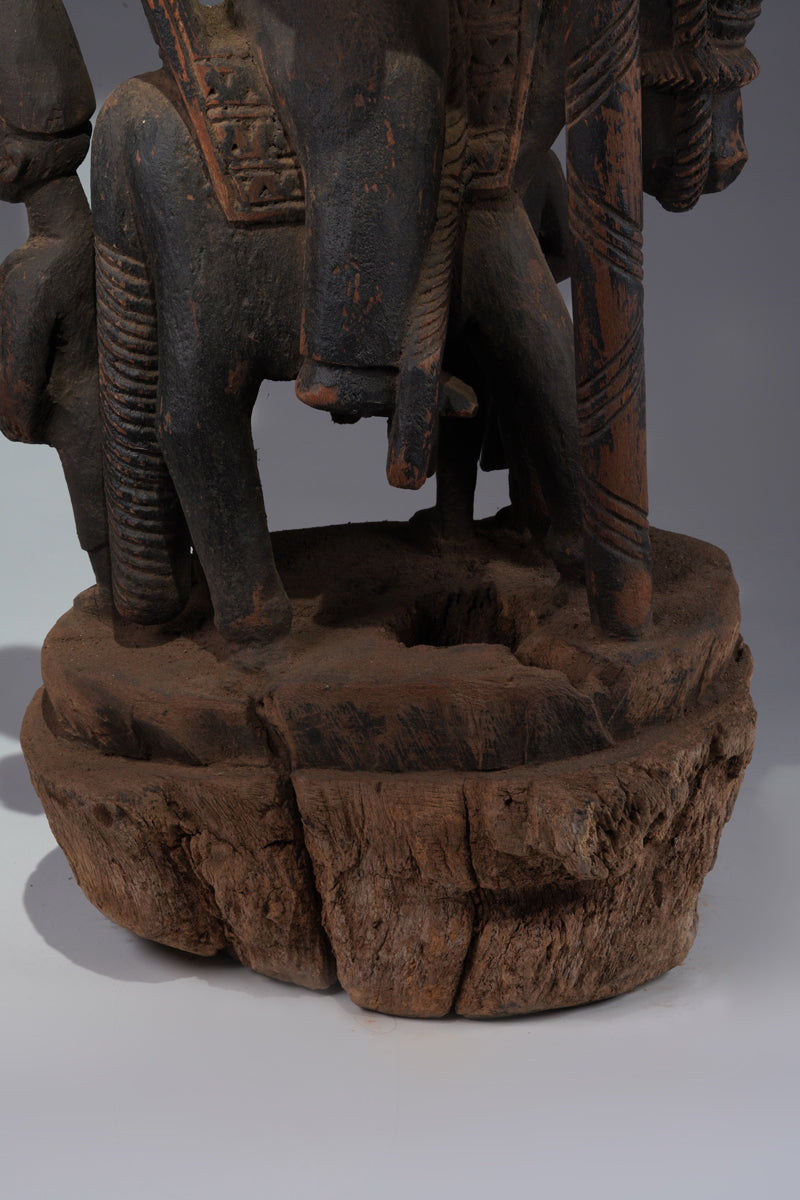
This impressive fragmentary Yoruba equestrian sculpture, collected in the Ekiti region of southwestern Nigeria, can most plausibly be attributed to the workshop of the celebrated master sculptor Olowe of Ise. Mounted on a weathered and heavily eroded wooden base, the sculpture preserves the essential qualities that distinguish Olowe's finest courtly carvings: dynamic composition, expressive figuration, and an extraordinary ability to transform a symbolic narrative into sculptural form.
The mounted rider is depicted as a figure of high rank, almost certainly a warrior, noble, or royal official. He holds a long spear in his left hand and a broad, curved ceremonial knife in his right, both emblems of military authority and political power within Yoruba courtly culture. Around him stand three smaller attendant figures, positioned beneath and beside the horse. These retainers, probably guards or soldiers, reinforce the hierarchical composition that is characteristic of Olowe's work, where differences in scale visually express differences in social status.
Although fragmentary, the horse itself remains remarkably expressive. One ear has been lost through age and use, yet its elongated proportions, powerful chest, slender legs, and carefully balanced stance closely resemble the horses appearing on Olowe's celebrated palace veranda posts. Rather than pursuing naturalistic anatomy, Olowe conceived the animal as an elegant architectural support whose rhythmic forms contribute to the sculpture's remarkable sense of movement and verticality.
The rider's head displays several of the distinctive stylistic features that have become synonymous with Olowe's workshop. The face is dominated by large projecting almond-shaped eyes that create an alert, commanding gaze. A gently arched nose projects prominently above the characteristic open mouth with its deeply carved lower jaw and the well-known "space tooth," one of the defining facial conventions repeatedly encountered in securely attributed works by the master. The carefully incised beard, the elaborate coiffure falling behind the neck, and the confident modelling of the head further strengthen the attribution to Olowe himself or to one of his most accomplished assistants working under his immediate supervision.
An Olowe of Ise Veranda post in shape of a horseman, left in the photo ,,Olowe of Ise, Veranda Posts in situ, inner courtyard, palace of the Ogoga, king of Ikere. Photos by William Flagg, from John Pemberton, “Art and Rituals for Yoruba Sacred Kings,” Art Institute of Chicago Museum Studies, volume 15, number 2 (1989), pp. 97–174
The sculpture bears a deep, naturally developed patina resulting from decades of ritual use, handling, and environmental exposure. Areas of abrasion reveal lighter wood beneath the darkened surface, while accumulated deposits and softened contours testify to prolonged use within its original cultural setting. These traces of age are not merely evidence of antiquity but form an integral part of the object's history, reflecting its long life as a revered work within a Yoruba palace or shrine environment.
Equestrian sculptures occupy a special place within Yoruba royal art. Horses were historically associated with political authority, military leadership, prestige, and access to long-distance trade networks. Mounted figures therefore represented not simply horsemen but idealized embodiments of power, courage, and noble leadership. Within palace architecture such sculptures celebrated the achievements of rulers and important chiefs while simultaneously serving as visual affirmations of legitimate authority and ancestral continuity.
Olowe of Ise (c. 1873–1938) is universally regarded as the greatest Yoruba sculptor of the late nineteenth and early twentieth centuries. Working primarily for royal courts throughout Ekiti and neighbouring Yoruba kingdoms, he transformed traditional architectural carving into a highly expressive sculptural language distinguished by fluid movement, dramatic spatial composition, and psychological vitality. His veranda posts, doors, shrine figures, and equestrian sculptures rank among the masterpieces of African art and have profoundly influenced subsequent generations of Yoruba sculptors. His characteristic vocabulary—including boldly projecting eyes, expressive open mouths, elegantly elongated figures, and dynamic compositions integrating multiple attendants—allows many works to be attributed with considerable confidence to his workshop.
The present sculpture embodies precisely these qualities. Despite its fragmentary condition, it remains an outstanding example of Olowe's artistic vision, combining technical virtuosity with powerful symbolic content. Its remarkable preservation of stylistic details, together with its richly developed patina and compelling composition, places it among the finest surviving examples of Yoruba equestrian sculpture attributable to the master's circle.
Selected Literature
Adams, Roland L., Master Sculptors of the Yoruba: Olowe of Ise. London, 1992.
Dark, Philip J. C., An Introduction to Yoruba Art. Oxford, 1973.
Drewal, Henry John, John Pemberton III & Rowland Abiodun, Yoruba: Nine Centuries of African Art and Thought. New York, The Center for African Art, 1989.
Blier, Suzanne Preston, African Vodun: Art, Psychology, and Power. Chicago, 1995.
Willett, Frank, African Art. London, 1971.
Art of the Yoruba. Exhibition Catalogue. New York: The Metropolitan Museum of Art, 1989.
Inv. No. CAB35340
Height: 134 cm
Weight: 21 kg