

Galerie Wolfgang Jaenicke
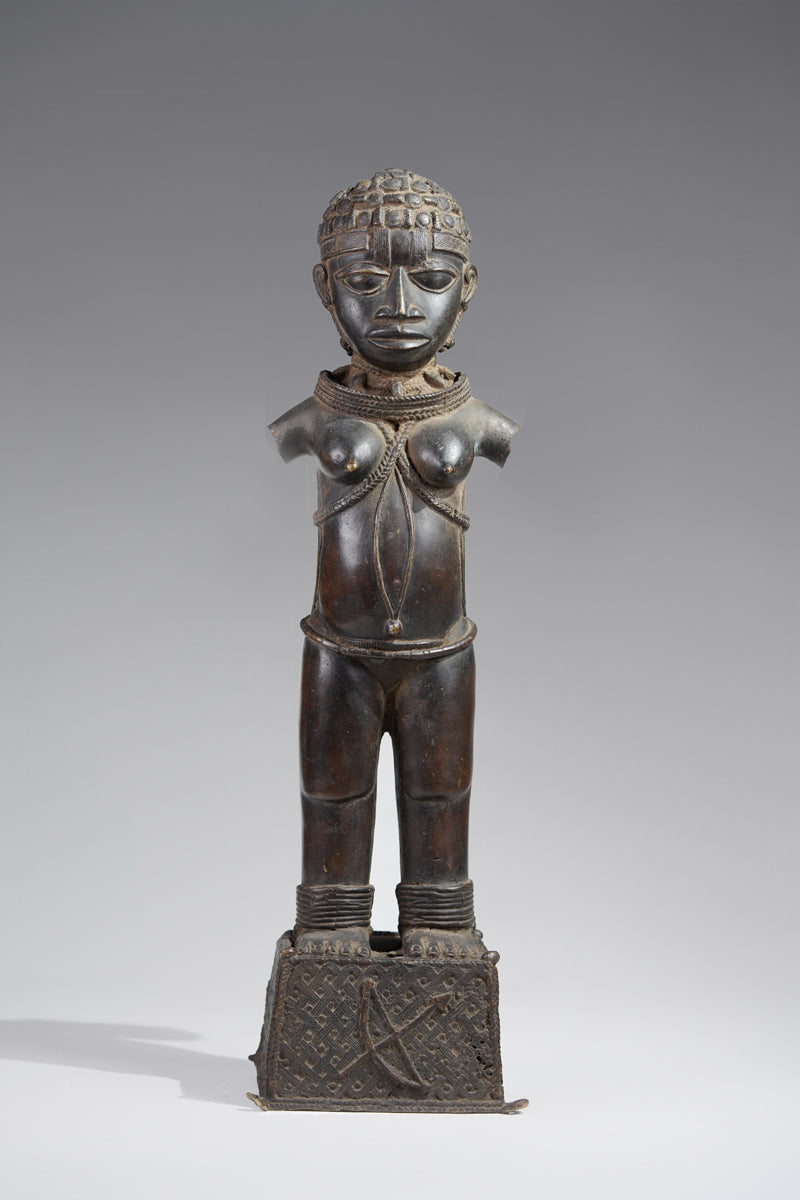
An Okhuo female Bronze sculpture
An Okhuo female Bronze sculpture
Couldn't load pickup availability
An Okhuo female Bronze sculpture, in the style of Benin, Nigeria, standing on a square plinth that is decorated with a bow and arrow, long flat feet, ankle bracelets, short legs, a necklace around the waist, a cylindrical body, a braided necklace around the neck crossing between her breasts, short arms rising towards the sky, the hands are upwards, open, she has a large rounded head composed of serene features, a closed mouth, pointed nose and two large eyes, her hair is short and composed of small lines and dots. The arms are reattached, by a later restoration, which has not the quality of the fragentary sculpture, documented in the last photo of this sequence.
"Many of these Okhuo represent young unmarried women, which we know as they are naked except for a girdle of Ekan or Ivie around their waist or hips. They would mostly likely have been maidens serving in the royal court of the Ọba or that of the Iy’Ọba.,"Source Digital Benin

The well known Okhuo female Bronze sculpture, which was restituted by the SPK (Stiftung Preußischer Kultur Besitz /Humboldtforum former Ethnological Museum Berlin, to Nigeria.
The term Okhuo refers to a particular category of female bronze representations within the cultural sphere of the Benin Kingdom, most often associated with courtly contexts and the visual codification of female prestige. These sculptures typically present a mature woman whose physiognomy and adornment communicate her role within the dynastic and ritual order of the palace.
In historical terms, such bronzes belong to a corpus shaped by the guild of brasscasters (Igun Eronmwon) serving the Oba. Their formal vocabulary combines idealised anatomy with the emblematic features of Benin court style: a carefully modelled coiffure, an emphasis on the curvature of the torso, and a compositional stillness that suggests controlled dignity. Female bronzes of this type are frequently interpreted as commemorative images of titled women, palace attendants, or royal mothers whose social agency is embedded in the reproductive and ritual maintenance of kingship.
Their significance draws from the political theology of the Benin court, where women of rank participated in the cyclical renewal of authority. In this sense the Okhuo sculpture functions as a mnemonic vehicle, linking the dynastic present to an ancestral continuum. Some examples show traces of red camwood or sacrificial patina, indicating their involvement in rites of invocation or remembrance.
Stylistically, the Okhuo bronzes reveal a tension between iconic fixity and subtle naturalism. The sculptural modelling of the eyelids, lips and chin recalls the canonical forms that matured between the sixteenth and eighteenth centuries, yet the articulation of jewellery and cloth registers the specific status of an individual whose ceremonial appearance would have been defined by palace sumptuary regulations.
Comparable works preserved in museum collections indicate that these sculptures served as part of larger assemblages placed on ancestral altars. Their function was therefore simultaneously devotional and historiographic, preserving the presence of significant women whose authority or motherhood contributed to the transmission of royal legitimacy.
Comparable works preserved in museum collections indicate that these sculptures served as part of larger assemblages placed on ancestral altars. Their function was therefore simultaneously devotional and historiographic, preserving the presence of significant women whose authority or motherhood contributed to the transmission of royal legitimacy.
The interpretation of Okhuo bronzes has been informed by early colonial records as well as later ethnographic testimonies, though these must be approached critically due to their fragmentary character. Scholarly analysis has repeatedly emphasised the intimate connection between feminine prestige and the metaphysical structure of monarchy in Benin, with the bronze medium itself underscoring permanence and dynastic endurance.
Fragmentary female bronzes attributable specifically to a named type such as “Okhuo female bronze” are uncommon in the online catalogues of major museums; images that do appear are more often single dealer records or aggregated catalogue entries for damaged masks or partial castings.²

Fragmentary Bronze sculpture in the style of Tada, former Wolfgang Jaenicke collection.
Text ceaated by AI
Jaenicke-Njoya Archive CAB22038
Height: 58 cm
Weight: 7,7 kg