

Galerie Wolfgang Jaenicke
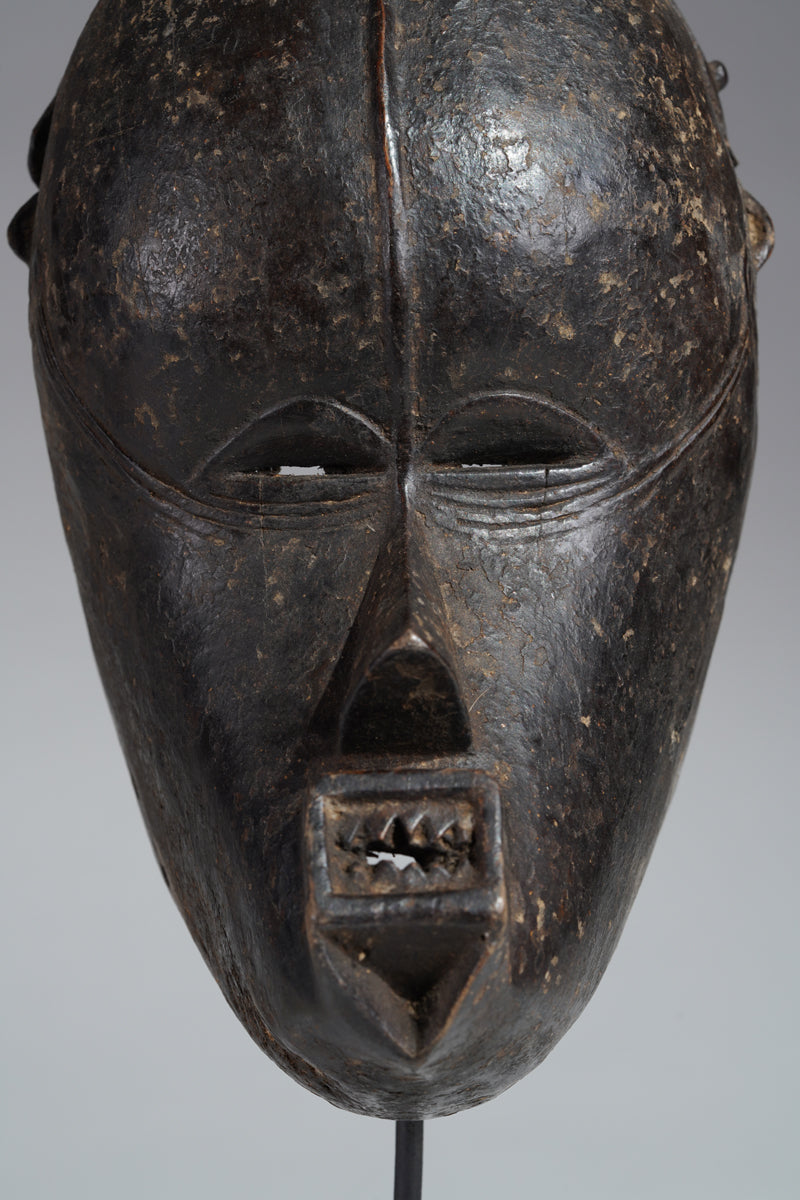
An imposant Beté mask
An imposant Beté mask
Couldn't load pickup availability
An imposant Beté mask, Ivory Coast, collected in the region of Gagnoa, with a prominent mouth and a bulging forehead, incl. stand, signs of age and ritual use, incl. stand, provenance Bakari Bouaflé, Abidjan.
Beté mask traditions from central-western Côte d’Ivoire form a heterogeneous corpus in which local styles articulate distinct conceptions of power, social regulation, and spiritual presence. Within this corpus, masks attributed to the Gagnoa region stand out for their particular balance between anthropomorphic clarity and expressive intensity. A comparative examination of Gagnoa masks alongside other Beté sub-styles reveals how regional variation reflects both ecological context and historically contingent social structures, while remaining anchored in shared Beté cosmological principles.
Across Beté society, masks are understood as embodiments of spirit forces rather than representational portraits. These forces intervene in moments of social tension such as funerals, initiations, disputes, or threats to communal cohesion. In this sense, all Beté masks function within a performative system in which movement, sound, and concealment of the human wearer are essential. However, the visual strategies through which these goals are achieved differ markedly between regions. In eastern and southeastern Beté areas, masks often display exaggerated abstraction: sharply protruding eyes, flattened or distorted facial planes, and highly aggressive features that verge on the monstrous. These forms emphasize alterity, underscoring the radical difference between human society and the spirit world.
By contrast, masks from the Gagnoa region tend toward a more explicitly human facial structure. While still highly stylized, they frequently present a coherent, frontal face with heavy volumes and symmetrical organization. This anthropomorphic emphasis does not diminish their power; rather, it intensifies their psychological impact by situating spiritual force within a recognizable human framework. The large eyes, broad noses, and tense mouths typical of Gagnoa masks suggest alertness and authority rather than chaotic aggression. The presence of vertical facial markings, often interpreted as scarification motifs, reinforces both identity and spiritual potency, anchoring the mask within local concepts of bodily inscription and moral status.
This stylistic orientation may be partially explained by Gagnoa’s position at a cultural interface with Gouro and Baoulé populations. Gouro masks, in particular, display a long-standing emphasis on balanced facial proportions and controlled expressiveness, qualities that appear to have influenced certain Beté workshops in the Gagnoa zone. Yet Gagnoa masks remain distinct from Gouro examples in their heavier carving, darker tonal treatment, and more forceful emotional charge. Where Gouro masks often evoke elegance and composure, Gagnoa masks project restrained menace and moral authority.
Within Beté classifications, many Gagnoa masks fall under the broad category often referred to as Gre or Gu masks, a flexible term encompassing masks associated with social control and ritual intervention. Comparison with Gre masks from other Beté regions highlights significant internal variation. Western Beté Gre masks are frequently more asymmetrical and visually aggressive, sometimes incorporating animal references or exaggerated grimaces. Gagnoa examples, by contrast, prioritize frontal confrontation and visual coherence, suggesting a different strategy of intimidation based less on shock and more on commanding presence.
Art-historically, this distinction complicates earlier typologies that treated Beté masks as a relatively uniform style defined primarily by ferocity and abstraction. Closer analysis demonstrates that Beté carving traditions encompass a spectrum ranging from extreme distortion to disciplined anthropomorphism. Gagnoa masks occupy a central position within this spectrum, mediating between abstraction and realism while maintaining strong expressive force. This balance has contributed to their particular appeal among collectors and scholars, who often regard them as especially refined yet emotionally powerful works.
Ethnographically, the effectiveness of Gagnoa masks lies in their ability to render spiritual authority intelligible and immediate. By approximating human facial structure while exceeding normal human expressiveness, these masks collapse the distance between the visible and invisible worlds. The spirit does not appear as something wholly other, but as an intensified, morally charged version of humanity itself. This conception aligns with Beté understandings of spirits as forces embedded in social life rather than remote, transcendent entities.
In sum, Beté masks from the Gagnoa region are distinguished not by isolation but by synthesis. They integrate broader Beté concepts of spiritual embodiment with regional aesthetic choices shaped by intercultural contact and local social needs. Their comparative study reveals the internal diversity of Beté art and underscores the importance of regional analysis for understanding African masquerade traditions beyond generalized stylistic labels.
Literatur
Colleyn, Jean-Paul. African Arts: Context, Form, and Meaning. Munich/New York: Prestel, 2009.
Leiris, Monique, and Jacqueline Delange. African Art. London: Thames & Hudson, 1967.
Reed, Daniel B. Dan Ge Performance: Masks and Music in Contemporary Côte d’Ivoire. Bloomington: Indiana University Press, 2003.
Vogel, Susan Mullin, ed. For Spirits and Kings: African Art from the Paul and Ruth Tishman Collection. New York: The Metropolitan Museum of Art, 1981.
Schoffel, Serge. Masques Bété et arts du centre-ouest ivoirien. Unpublished research dossier, various editions.
CAB30304
Height: 27 cm
Weight: 1,4 kg