

Galerie Wolfgang Jaenicke
An Ife Bronze Couple
An Ife Bronze Couple
Couldn't load pickup availability
An Ife Bronze Couple: Mother and Son, Royal Authority and the Ife–Benin Connection.
The bronze couple published by Frank Willett in Ife (1957, p. 37, pl. 10), and related to the fragmentary example excavated at Ita Yemoo (p. 75, pl. III; discussed on p. 72), belongs to one of the rarest categories of Yoruba metal sculpture. Unlike the famous individual heads and standing figures from Ile-Ife, paired compositions are exceptionally uncommon and therefore occupy a special position within the corpus of medieval Nigerian court art. The archaeological association with the Ita Yemoo discoveries further enhances the importance of this iconography.
Ile-Ife, regarded in Yoruba tradition as the sacred birthplace of the world and the ancestral seat of kingship, produced between the twelfth and fifteenth centuries some of the most accomplished copper-alloy sculptures known from Africa. Their remarkable naturalism, technical sophistication, and subtle modeling challenged early European assumptions about African artistic achievements and are today recognized as one of the high points of world sculpture.
The identification of the bronze couple remains open to interpretation. One convincing reading sees the male figure as an Ooni of Ife and the female figure as the Queen Mother, represented as complementary holders of ritual and political authority. The equality of scale, balanced composition, and corresponding regalia emphasize institutional duality rather than marital intimacy. Such a conception corresponds closely to Yoruba ideas of balanced male and female spiritual power in governance.
A second interpretation, particularly relevant in the context of Benin royal ideology, identifies the pair as a mother and her royal son. This reading evokes the powerful tradition of the Iyoba (Queen Mother) in the Kingdom of Benin. The most famous historical example is the relationship between the celebrated Oba Esigie and his mother Idia. According to Benin oral traditions, Idia played a decisive role in securing her son's throne during periods of political conflict and military campaigns. Following Esigie's victories, she became the first Queen Mother officially invested with extraordinary court privileges and her own palace. Thereafter, the maternal bond became a central symbol of dynastic legitimacy in Benin art.
The mythology surrounding Oba Esigie and Queen Mother Idia transcends biological motherhood. The Iyoba embodies wisdom, protection, supernatural support, and the transmission of royal destiny. In Benin visual culture, the mother legitimizes kingship, while the son manifests its earthly realization. A sculptural representation of mother and son therefore expresses not simply family relations but the continuity of sacred kingship itself. This concept resonates strongly with broader Yoruba notions of ancestral authority and may explain why similar paired images could be meaningful in both Ife and Benin contexts.
The rarity of such bronze couples cannot be overstated. While hundreds of Benin plaques and numerous Ife heads are known, complete paired compositions of this type remain extremely scarce. The fragmentary Ita Yemoo example published by Willett demonstrates that the motif existed archaeologically, yet very few examples survive in a condition allowing detailed iconographic analysis. The combination of a published comparative example and archaeological parallels therefore makes this group particularly noteworthy within the field of Nigerian court sculpture.
The historical relationship between Ife and Benin further enriches the significance of the sculpture. Benin royal traditions maintain that elements of kingship and court culture originated in Ife and were transmitted to Benin through dynastic connections. Art historians have long noted similarities in regalia, royal symbolism, and casting traditions between the two centers. Although each kingdom developed a distinct artistic language, both shared a conception of sacred kingship in which rulers derived authority from divine and ancestral sources. The bronze couple may therefore be viewed as a visual bridge between the ideological worlds of Ife and Benin.
The present example was exhibited in the Ife – Benin Exhibition at the Wolfgang Jaenicke Gallery, Berlin, in August 2018, where it formed part of a broader exploration of the artistic and historical connections between these two great centers of Nigerian civilization. The exhibition emphasized the shared heritage of royal imagery, metallurgical excellence, and sacred kingship that links medieval Ife with the later Benin Kingdom.
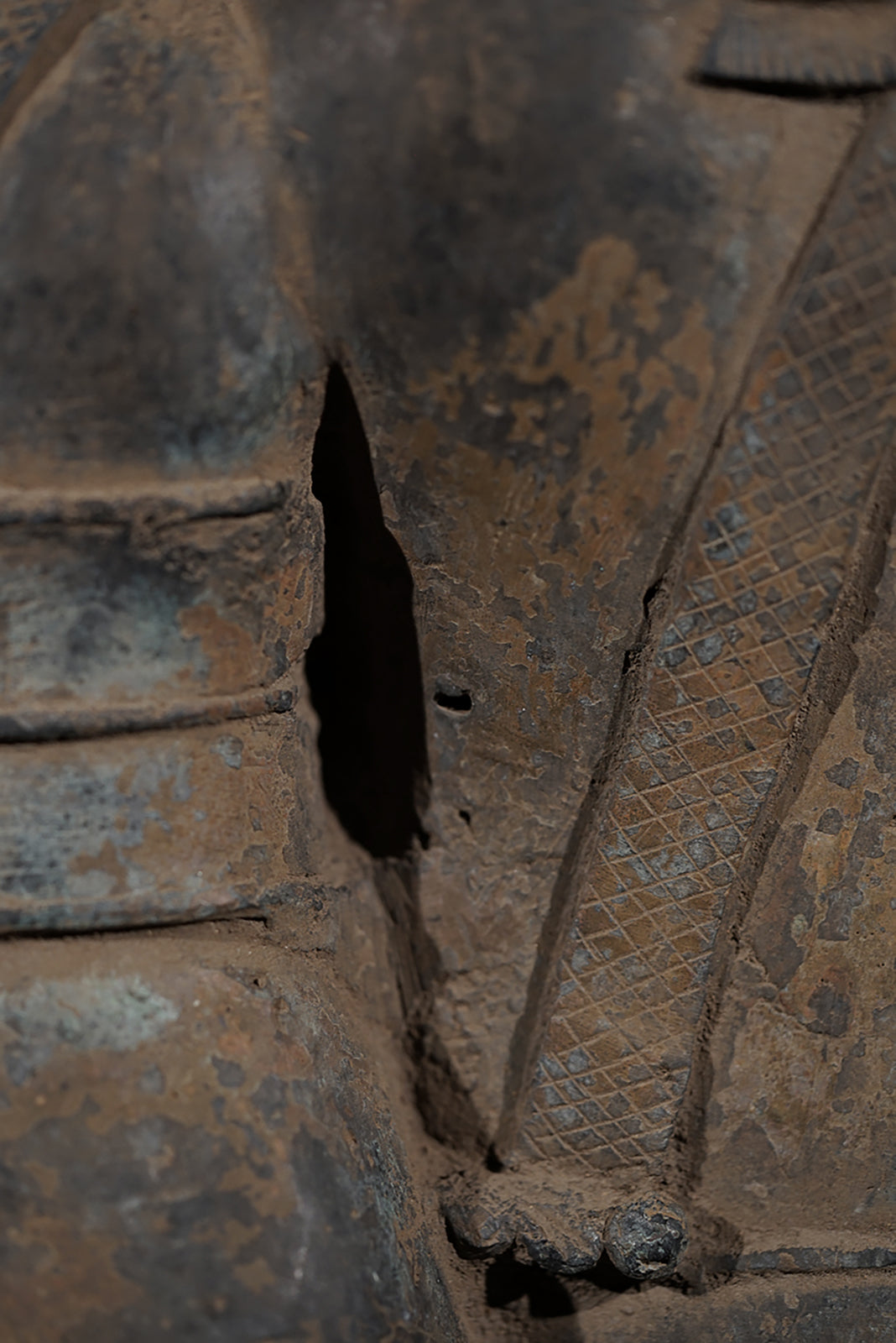
Condition report: many layers of encrusted oxidation, on the right arm of the female sculpture is an unprofessional repair, which was done obviously later. If this repair is recent a technincal analysis according of the TL analysis will indicate, that this sculpture is recent, because the sculpture was heated to a temperature during the restoring process, in which a technical analysis verifies a "recent" sculpture. But according of the TL-Test the minimum age is at least about 550 years
References
Frank Willett, Ife, London, 1957, pp. 37, 72, 75, pl. 10, pl. III.
Frank Willett, “On the Funeral Effigies of Owo and Benin and the Interpretation of the Life-Size Bronze Heads from Ife, Nigeria,” Man, Vol. 1, No. 1, 1966, pp. 34–45.
Suzanne Preston Blier, Art and Risk in Ancient Yoruba: Ife History, Politics and Identity c.1300, Cambridge University Press, 2015.
Frank Willett, The Art of Ife, London, various editions.
Barbara Blackmun, The Benin Kingdom and the Edo-Speaking Peoples of South-Western Nigeria.Paula Ben-Amos, The Art of Benin.
TL Analysis Kotalla 550 years + / - 16 %.
Height: 66 cm
Weight: 18,8 kg
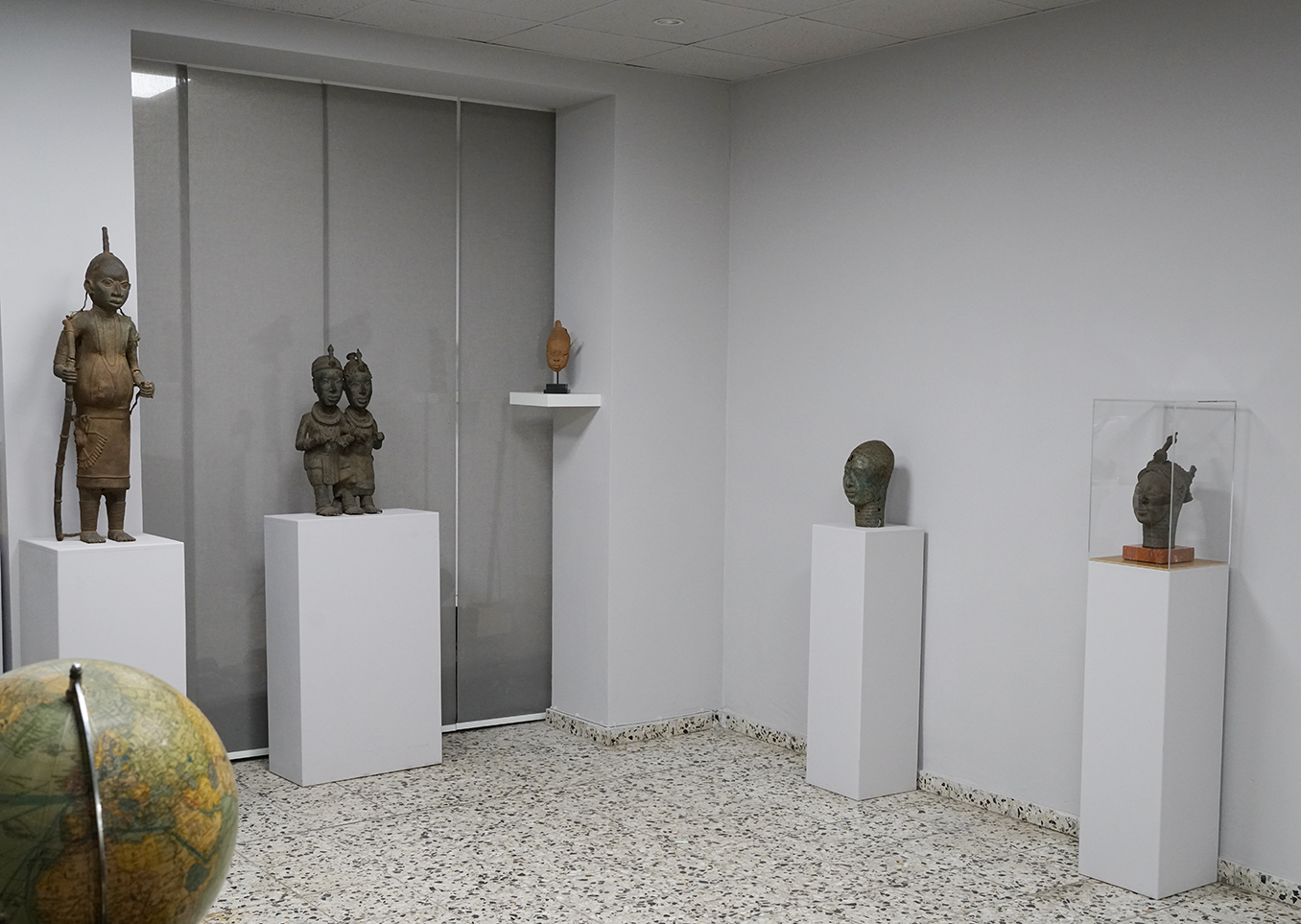
Ife -The Ife-Benin Exhibition August 2018, Wolfgang Jaenicke Gallery, Berlin.