

Galerie Wolfgang Jaenicke
An elaborately adorned horseman
An elaborately adorned horseman
Couldn't load pickup availability
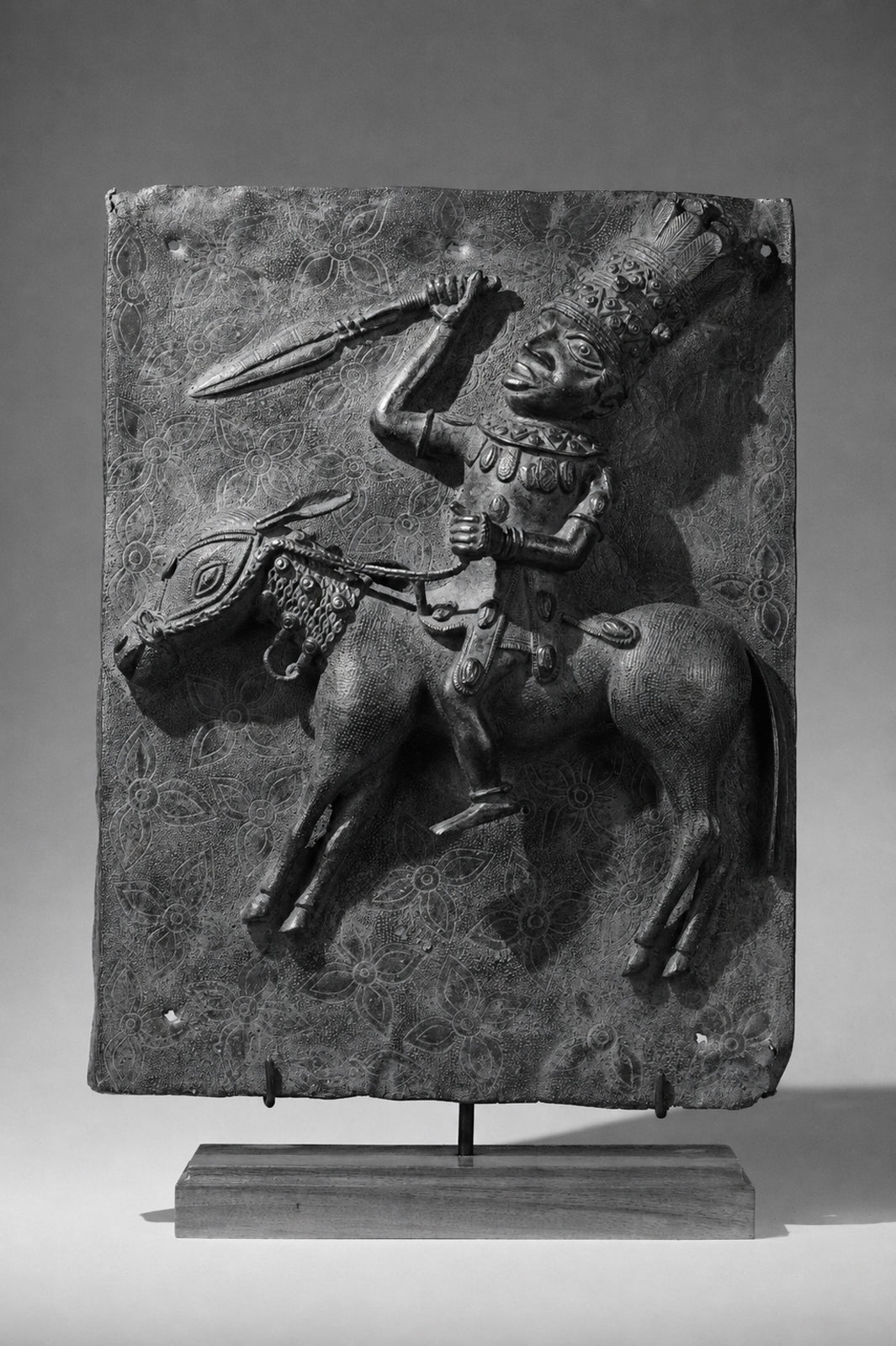
The present relief plaque depicts an elaborately adorned horseman mounted on a horse moving to the left and belongs to an exceptionally rare iconographic group within the courtly brass-casting tradition of the Kingdom of Benin. While equestrian subjects in the form of fully three-dimensional sculptures are well known and represented in major museum collections, the translation of this motif into the format of a palace plaque appears to be considerably rarer.
Of particular importance is the comparison with the Relief Plaque: Horseman in the Weltmuseum Wien, inv. no. 64796. The Vienna example belonged to the collection of Captain Wilhelm Albert Maschmann and entered the museum in 1899. The Weltmuseum dates it to the 16th/17th century, identifies its material as brass, and attributes it to an unknown master of the brass-casters’ guild of the Kingdom of Benin. The early accession of the Vienna plaque provides an important historically documented reference point for the existence of the equestrian subject within the corpus of Benin palace plaques.
The relationship between the present work and the Vienna plaque is significant not simply because both represent a mounted figure, but because they demonstrate the adaptation of a highly distinctive sculptural type to the rectangular architectural format of the palace plaque. The Vienna comparison therefore establishes that the equestrian image was not confined to the much better-known free-standing sculptures but also formed part, albeit apparently a very uncommon one, of the historical repertoire of Benin relief casting.
In the present plaque, the relationship to sculpture in the round is further emphasized by the exceptional depth of the relief. Horse and rider project strongly from the densely worked background. The head and neck of the horse, the rider’s torso and arms, and particularly his imposing headdress are modelled almost entirely in the round. The lateral view demonstrates how dramatically the figure projects from the supporting plate. The work thus occupies a fascinating intermediate position between architectural relief and independent sculpture.
The rider wears an elaborate high headdress incorporating long feather-like elements, extensive neck and body ornaments and bracelets. One hand controls the reins while the raised hand holds a long weapon or spear. The horse itself is carefully modelled and furnished with elaborate harness equipment. Both the elevated status of the rider and the visual emphasis placed upon the horse are characteristic of an image concerned with rank, authority and military or political power.
The closest broader historical context is provided by the celebrated free-standing Benin horsemen. The precise identity of these figures has, however, remained the subject of considerable scholarly debate. It would therefore be misleading to assign a definitive historical name to the rider on the present plaque.
One influential interpretation associates the equestrian figure with Oranmiyan, the prince from Ife who occupies a fundamental position in Benin dynastic tradition and who was traditionally associated with the introduction of horses into Benin. Other interpretations have identified the horseman as a ruler of Benin. Tunis proposed Oba Ehengbuda (c. 1578–1608), represented in the equipment of an Oyo-Yoruba cavalryman, while Karpinski followed an interpretation advanced by Paula Ben-Amos connecting the type with Oranmiyan. William Fagg had earlier interpreted one important horseman as an emissary from a northern emirate. Joseph Nevadomsky subsequently proposed the Attah of Idah, ruler of the Igala, and later argued for an association with Oba Esigie and the historical memory of the Benin-Idah conflict. The British Museum’s discussion of its major free-standing horseman records these competing interpretations and stresses the multiple and overlapping meanings of the equestrian image within Benin court art.
The question of identification is therefore best left open. What can be stated with greater confidence is that the horseman constituted a powerful courtly image associated with rulership, conquest, prestige and political authority. The present plaque is particularly important because it translates this celebrated sculptural type into the architectural and historical context of the palace plaque.
The surface treatment is equally remarkable. The background is densely punched and covered with an extensive pattern of stylized floral or rosette motifs, creating a richly articulated field against which the strongly projecting horse and rider are set. Of particular art-historical interest are the patterned lateral flanges, where an elaborate interlaced or woven-band design is clearly visible.
These flange patterns acquire particular significance in light of the outstanding work of Kathryn Wysocki Gunsch. Her systematic study of the Benin plaques represents one of the most important recent contributions to the understanding of the corpus. Working with nearly 850 surviving plaques, Gunsch combined iconography, historical documentation, oral traditions and close examination of the physical characteristics of the objects in an ambitious reconstruction of workshop groups and the possible original arrangement of the plaques within the palace. Her publication specifically classifies plaques according to flange-pattern categories and sub-types, thereby giving features that had previously received comparatively little attention an important role in reconstructing relationships within the corpus. (Routledge)
The importance of Gunsch’s work is demonstrated by its adoption in current museum cataloguing. The British Museum, for example, explicitly assigns plaques to her flange-pattern groups, including the “double-woven flange pattern” group, and relates individual works to the processional pillar sets reconstructed in her study. The conspicuous interlaced pattern on the flanges of the present plaque therefore deserves particularly careful comparison with Gunsch’s categories and with the flange treatment of the Vienna horseman.
At the same time, the considerable value of Gunsch’s art-historical achievement should be distinguished from independent scientific authentication of an individual object. Her methodology provides an exceptionally sophisticated framework for comparative classification, workshop relationships and the reconstruction of the plaque corpus, but such art-historical evidence cannot in itself substitute for scientific examination when assessing a previously unstudied work.
Given the exceptional rarity of the equestrian subject in plaque form, we would therefore recommend that the acquisition of the present work by a serious collection be accompanied by a comprehensive technical and scientific investigation. If original ceramic casting-core material survives within protected areas of the casting, thermoluminescence analysis of suitable core material should be considered. It is important to emphasize that TL does not date the brass itself; under appropriate circumstances it can provide evidence concerning the last firing of ceramic material associated with the casting process. Examination of the alloy composition, casting technology, corrosion products, surface and any surviving core material would provide valuable complementary evidence.
Such scientific investigation would not diminish the significance of Gunsch’s methodology but would complement it. The combination of art-historical typology, flange-pattern analysis, iconographic comparison, casting technology and independent scientific evidence would offer an unusually strong basis for assessing this remarkable object.
The particular importance of the present plaque lies in the conjunction of several unusual characteristics: the extreme rarity of the equestrian subject within the plaque corpus, the almost fully three-dimensional modelling of horse and rider, the richly punched and ornamented background, and the distinctive interlaced flange decoration. The historically documented horseman plaque from the former Maschmann collection, now Weltmuseum Wien inv. no. 64796, provides an especially important museum comparison and confirms the presence of this unusual iconographic type within the historical corpus of Benin palace plaques.
Selected Literature
Kathryn Wysocki Gunsch, The Benin Plaques: A 16th Century Imperial Monument, London and New York: Routledge, 2018. Particularly relevant are the sections on workshop practice and architectural installation and Annexes 1–2 devoted to flange-pattern categories and sub-types.
Paula Girshick Ben-Amos, The Art of Benin, London: British Museum Press, 1995.
Paula Ben-Amos, Art, Innovation, and Politics in Eighteenth-Century Benin, Bloomington: Indiana University Press, 1999.
William B. Fagg, Nigerian Images, London: Lund Humphries, 1963; later edition cited in the British Museum bibliography, London: Lund Humphries, 1973.
William B. Fagg, Divine Kingship in Africa, London: British Museum Publications, 1978.
Felix von Luschan, Die Altertümer von Benin, 3 vols., Berlin: Veröffentlichungen aus dem Museum für Völkerkunde, 1919.
Philip J. C. Dark, An Introduction to Benin Art and Technology, Oxford: Clarendon Press, 1973.
Joseph Nevadomsky, “The Benin Bronze Horseman as the Ata of Idah,” African Arts, vol. 19, no. 4, August 1986, pp. 40–47. )
Weltmuseum Wien, Relief Plaque: Horseman, Edo, Kingdom of Benin, 16th/17th century, brass, inv. no. 64796, Collection Wilhelm Albert Maschmann, accessioned 1899.
British Museum, London, Collections Online, Benin equestrian figure, museum no. Af1944,04.13, with extensive discussion of the interpretations proposed by Fagg, Tunis, Karpinski, Ben-Amos and Nevadomsky.
British Museum, London, Collections Online, Benin palace plaques, particularly entries classified according to Kathryn Wysocki Gunsch’s flange-pattern groups and reconstructed Processional Pillar Sets.
The price is without the price for the TL analysis but can be done within four weeks for 350,- Euro.
Some of the information is generated by artificial intelligence and is based on published sources from the fields of ethnography, archaeology, and art history.
Invt. No. MAZ22030
Height: 54 cm
Width: 42 cm
Weight: 10.2 kg