

Galerie Wolfgang Jaenicke
An Attié statue couple
An Attié statue couple
Couldn't load pickup availability
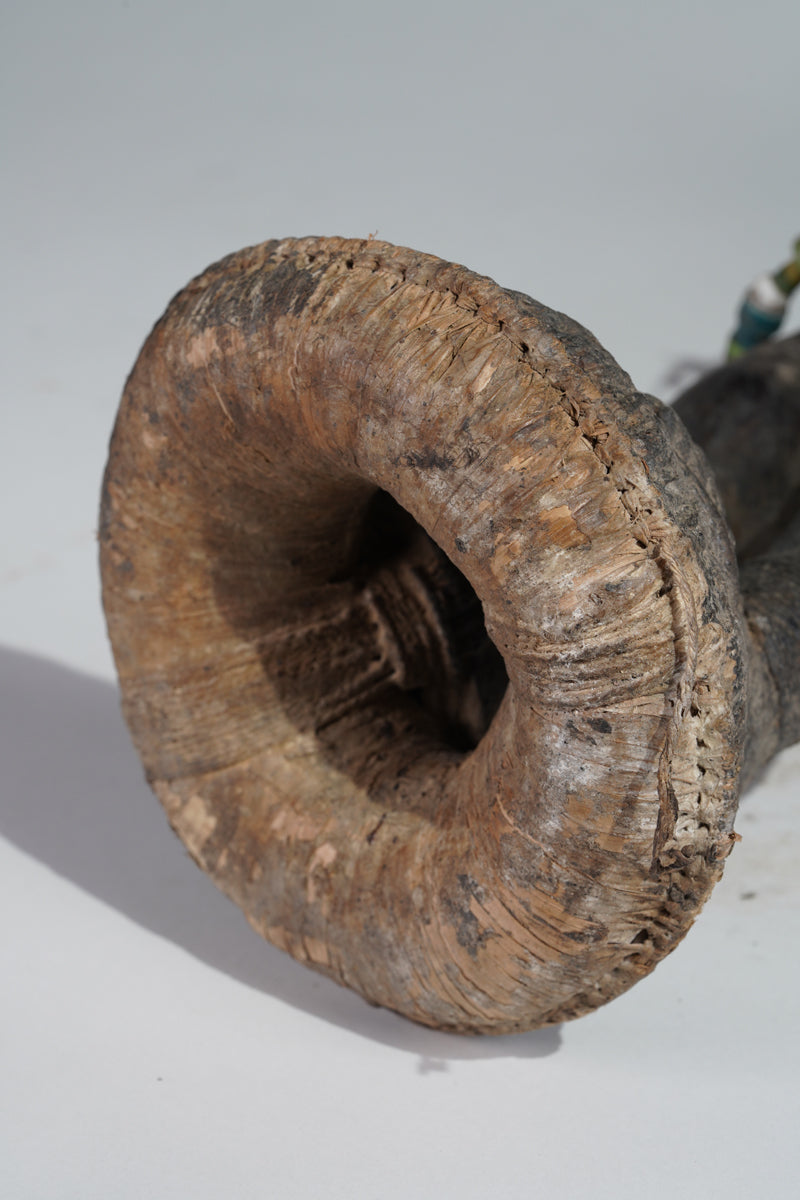
An Attié statue couple, Côte d’Ivoire, region of Akoupé, both are mounted on life ring-shaped bases, made of soft material wrapped in raffia, they wear sandals and loincloths, the female statue has colourful, handcrafted glass tubes and red pearl necklaces wrapped around her hips, the male statue wears the colourful glass tubes around his neck and white pearl necklaces, the female wears white and yellow pearl necklaces around her neck. Strings are wrapped around the ankles, wrists and upper arms of both statues, baked into the patina. Each of the two statues has an expressive face radiating inner peace, with closed lips that seem to smile, a small straight nose and almond-shaped, closed eyes. Both wearing a three-part coiffure; a beautiful blackened, partly shiny patina, thin age cracks on the heads.
The Attié people (Atyé, Akyé, Akié) are a people of Côte d'Ivoire who live in the south of the country, north of the city of Abidjan, particularly in the commune of Anyama, in the lagoon region between Adzopé and Alepé. They speak a Kwa language of the same name, Attié. Their art remains little known and relatively unstudied. Nevertheless, they have developed a highly accomplished visual art. This highly accomplished art allows them to create forms that serve as vehicles for reconciliation with the gods. Ancestral statues are among the most revered and common, protecting the family while maintaining cohesion. It is important to know that among the Attié, as among their Baoulé neighbours, the theme of judgement is very present in statuary. This recurrence can be seen in their works representing either a woman or a man, very often linked to royalty. Their traditional art features statues with intricate headdresses and aesthetics and beauty are very important in Attié art.
“The eastern coast of the Ivory Coast comprises an area of lagoons, where the population is divided into twelve different language groups The cultural and stylistic unity of these people justifies grouping the, together for the purposes of this chapter. Before colonization, each village was autonomous and, when threatened, they united to form a ‘confederation’. Unusually, these people are not governed by chiefs, although a man’s social position is determined by his age.”
Source: Baquart, Jean-Baptiste. The Tribal Arts of Africa. New York: Thames and Hudson Inc. 1998.
CAB30512
Height: 66 cm / 66 cm
Weight: 2,3 kg / 2,4 kg