

Galerie Wolfgang Jaenicke
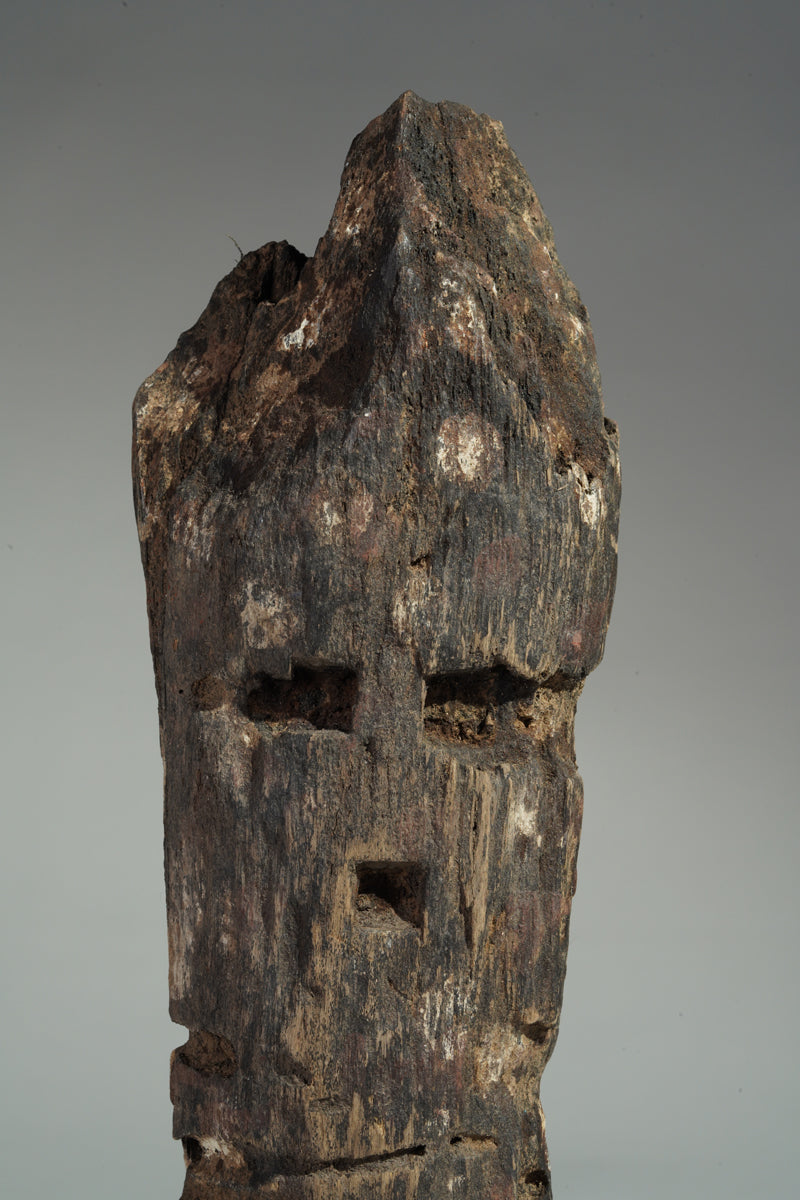
Adan Fetish
Adan Fetish
Couldn't load pickup availability
Adan Fetish Sculpture,
Tsévié Region, Togo
Geographical attribution according to the informant Batoure
This slender, strongly elongated anthropomorphic figure is carved from a single piece of wood. The tall, almost columnar head tapers towards an irregularly pointed crown. The face is reduced to a few striking features: two deeply recessed rectangular eyes and a small hollowed mouth, while the nose is only faintly indicated or no longer discernible. Pronounced vertical grooves structure the surface of the head, while several horizontal incisions articulate the transition between the head and the lower part of the figure. The body is considerably more fragmentary, with deep cavities, losses and extensive surface erosion that obscure its original anatomical form.

Waste disposal site, NY, near Brooklyn, around 1950.
The wood displays a dark brown to blackish-brown surface with lighter ochre, grey and whitish deposits. Extensive weathering, encrustation and material loss contribute to the sculpture’s highly reduced and elemental anthropomorphic presence. The precise causes of the cavities and surface alterations, whether resulting from prld be retained as part of the object’s recorded provenance. The designation “Adan” is best understood with some caution, however, since the terms Adan, Ada, Adangbe or Dangme and Ewe have not always been applied consistently in the literature on West African sculpture and particularly in the art market. A designation such as “Adan / Adangbe, Tsévié region, Togo, according to the informant Batoure” therefore preserves the historical information associated with the object without presenting the cultural attribution as more certain than the available evidence permits.
Selected literature
Antes, Horst, ed., with Gigi Pezzoli, Philipp Plath and Nii Quarcoopome. Aklama: Helper Spirits of the Ewe and Dangme from the Study Collection of Horst Antes. Studienstiftung Horst Antes, 2016.
Blier, Suzanne Preston. African Vodun: Art, Psychology, and Power. Chicago and London: University of Chicago Press, 1995.de Surgy, Albert. Le système religieux des Evhé. Paris: L’Harmattan, 1988.Sprigge, R. G. S. “Eweland’s Adangbe: An Inquiry into an Oral Tradition.” Transactions of the Historical Society of Ghana 10, 1969, pp. 87–128.Yates, Michael. “Strange but Somehow Beautiful: Art of the Adan People of South-East Ghana.”Yates, Michael. “Styles in Adan Figurative Carvings.” 2012.

Inside of a fine Art gallery, NY, Manhatten, with the sculpture and a photo of the the waste disposal site, around 1950.
The attribution to the Adan and the recorded origin in the Tsévié region of Togo are not necessarily contradictory. Although sculptures identified as Adan are frequently associated with southeastern Ghana, historical sources document Adangbe communities in Togo, including settlements in the immediate vicinity of Tsévié. R. G. S. Sprigge’s study of the Adangbe in Eweland demonstrates the historical presence of an Adangbe population within an otherwise predominantly Ewe cultural and linguistic environment in Togo. Historical settlement research further locates an Adangbe community on the Haho River approximately fourteen kilometres northeast of Tsévié.
The information supplied by the informant Batoure, identifying the sculpture with the Tsévié region, is therefore geographically plausible.
Some of the information is generated by artificial intelligence and is based on published sources from the fields of ethnography, archaeology, and art history.
Inv. No. MAZ25550
Height: 37 cm
Weight: 760 g (incl. stand)