

wolfgang-jaenicke
A Veranda post attributed to Agbonbiofe Adeshina
A Veranda post attributed to Agbonbiofe Adeshina
Couldn't load pickup availability
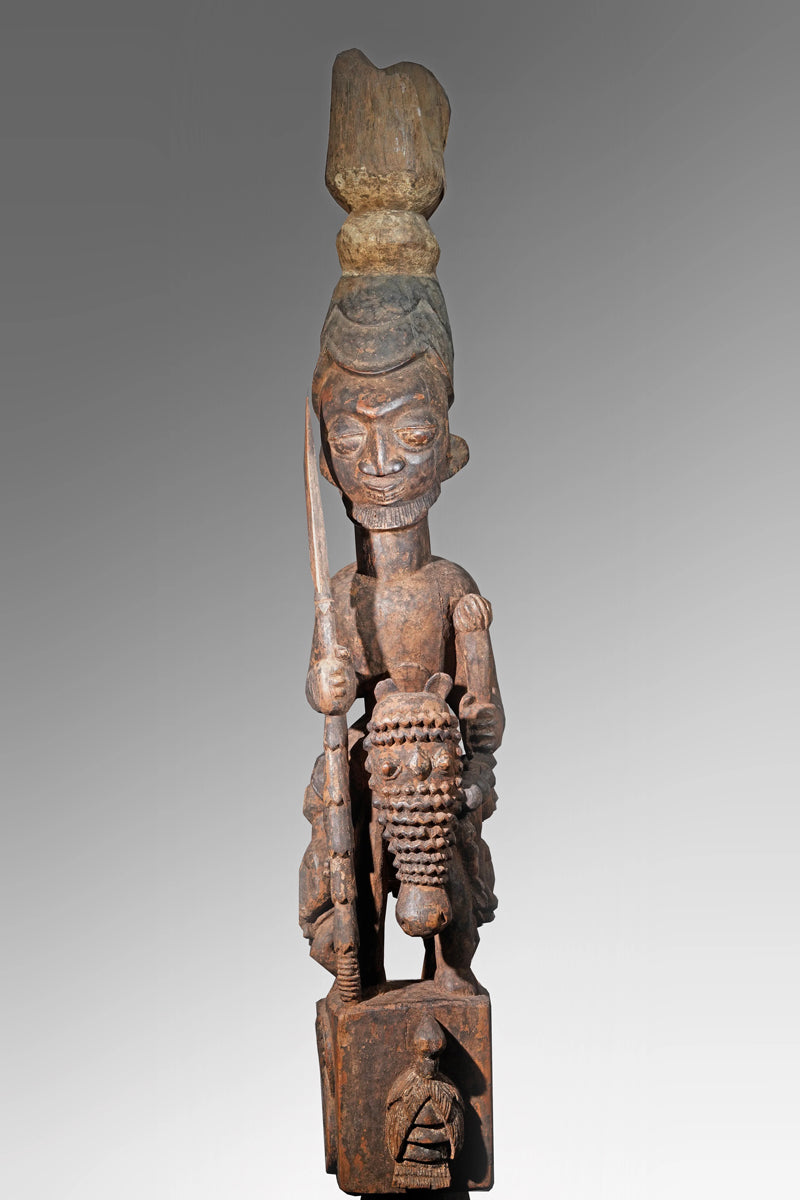
A Veranda post attributed to Agbonbiofe Adeshina (Efon-Alaye, c. 1880 - 1945). It seems to be an early work, we suggest a date well before 1912. The figures are not yet as "sharp-edged" as in his later work, the heads are still somewhat rounder and do not yet sit on the later gently curved neck. Everything seems a little squat, but Adeshina's very special expression is already clearly discernible. It is the curved hairline resp. head crest, the pursed lips, the horses' "knobbly" nose, their small ears, the beaded bridle. It is extremely unusual that the king was depicted twice on top of each other on a veranda post. This form of depiction is utterly unique. A truly special piece in a beautiful state of preservation.
Agbonbiofe Adeshina also carved the posts for the Yoruba royal palace in Efon-Alaye (1912-1916), where they supported the roof of a veranda lining the king’s reception courtyard.
"The sculptor Agbonbiofe was the most prominent of the Adeshina family of artists from the town of Efon-Alaaye, during the first decades of the 20th century." Saint Louis Art Museum
"Most of the African master carvers remain unidentified. But some artists are known and are still remembered and celebrated today. Agbonbiofe, a member of the famous Adeshina carver family, is one of them." Minneapolis Institute of Art
Lit.: "Acquisitions of the Art Museum 1993", Record of the Art Museum, Princeton University 53, no. 1 (1994): p. 46-95., pp. 93–94 (illus.) Peter Mark, "Is There Such a Thing as African Art?," Record of the Art Museum, Princeton University 58, no. 1/2 (1999): 7–15., p. 14, fig. 6 "Selected checklist of objects in the collection of African art," Record of the Art Museum, Princeton University 58, no. 1/2 (1999): p. 77–83., p. 83. Milwaukee, Wisconsin, Milwaukee Public Museum, Selections from The William W. Brill Colllection of African Art, 1969: 24, catalogue of the exhibition, Milwaukee Public Museum, May 5 - August 31, 1969 (for additional venues see bibliography, Milwaukee 1969). The Housepost with Mounted Warrior by Agbonbiofe Adeshina, For the Palace of the Alaaye of Efon, Efon-Alaaye, Ekiti, Nigeria Edwin and Cherie Silver, Los Angeles, acquired in 1971. John Pemberton III, Art and Rituals for Yoruba Sacred Kings, Art Institute of Chicago Museum Studies, Vol. 15, No. 2 (1998). Alisa LaGamma, Authorship in African Art, African Arts, Vol. 31, No. 4, Special Issue: Authorship in African Art, Part 1 (Autumn 1998). Alisa LaGamma, Beyond Master Hands: The Lives of the Artists, African Arts, Vol. 31, No. 4, Special Issue: Authorship in African Art, Part 1 (Autumn 1998). On Sothebys a similar Veranda post was auctioned for nearly 400 000,- USD in 2017 from the Collection of Edwin & Cherie Silver
Other pieces by Agbonbiofe Adeshina can be found at:
Minneapolis Institute of Art
Saint Louis Art Museum
British Museum
The Cleveland Museum of Art
Ackland Art Museum
The Artist was active in the town of Efon-Alaye in present-day Ekiti State, belongs to a circle of early twentieth-century Yoruba master carvers whose work formed a distinct local school associated with refined surface treatment and a predilection for elongated proportions. His career unfolded during a period in which Efon-Alaye had become a regional centre of commissioned carving, supplying palace contexts, lineage shrines and civic institutions in neighbouring towns.¹
Adeshina’s oeuvre is not documented through signed works, yet a number of stylistically coherent sculptures have been attributed to him by formal comparison with objects collected in situ during the 1920s and 1930s. These works often reveal a linear conception of facial modelling, an emphasis on the vertical articulation of coiffure and headdress, and a carefully balanced posture that suggests ceremonial gravitas rather than narrative dynamism.² The wood surfaces were traditionally finished with layers of palm-oil patina, resulting in a soft lustre that accentuates the clarity of the carving.
Local oral accounts describe him as a carver who worked closely with court officials and specialist priests, adapting established Yoruba iconographic conventions to the demands of patrons undergoing sociopolitical changes in the colonial era.³ The persistence of Efon-Alaye stylistic traits in later regional workshops suggests that his generation helped stabilise a visual vocabulary that remained influential well into the mid-twentieth century.
¹ For the emergence of Efon-Alaye as a carving centre, see regional surveys of Ekiti woodcarving traditions.
² Comparative attributions rely on field collections made under colonial administrative oversight in the interwar years.
³ Oral histories transmitted in Efon-Alaye emphasise his collaboration with palace dignitaries and ritual associations.
Agbonbiofe Adeshina (Efon-Alaye, c. 1880–1945) and Olowe of Ise (c. 1873–1938) both belong to the classical period of Yoruba woodcarving, but they come from different regional schools and cultural contexts. Olowe worked in the Ise area, in present-day Ekiti/Osun, and was particularly renowned for his palace and shrine carvings, characterized by complex compositions, rich reliefs, and figural groupings. Adeshina, by contrast, worked in Efon-Alaye, a smaller center, and his works are distinguished by a more linear treatment of facial features, an emphasis on verticality, and a calm, statuary posture of the figures.¹
Both artists were active in overlapping periods, and it is conceivable that they were indirectly influenced by each other through broader regional Ekiti traditions, which shared stylistic elements such as proportions or certain iconographic motifs. However, there is no evidence of direct personal contact or a formal teacher–student relationship. The “relationship” is therefore primarily stylistic and contextual: both contributed to the development of Yoruba woodcarving in the late nineteenth and early twentieth centuries but represent different regional and aesthetic trajectories.²
¹ Drewal 1989; regional surveys of Efon-Alaye carving traditions.
² Comparative studies of Yoruba palace sculpture.
DSC6276
"I believe that the import of all art objects from Africa—whether copies or originals—should be prohibited to protect Africa." Quote: Prof. Dr. Viola König, former director of the Ethnological Museum of Berlin, now HUMBOLDTFORUM
Legal Framework
Under the 1970 UNESCO Convention in combination with the Kulturgutschutz Gesetz (KGSG) any claim for the restitution of cultural property becomes time-barred three years after the competent authorities of the State of origin obtain knowledge of the object’s location and the identity of its possessor.
All bronzes and terracotta items offered have been publicly exhibited in Wolfgang Jaenicke Gallery since 2001. Organisations such as DIGITAL BENIN and academic institutions such as the Technical University of Berlin, which have been intensively involved in restitution-reseaches (translocation-project) over the past seven years, are aware of our work, have inspected large parts of our collection and have visited us in our dependance in Lomé, Togo, among other places, to learn about the international Art trade on site. Furthermore, the National Commission for Museums and Monuments (NCMM) in Abuja, Nigeria, has been informed about our collection. In no case in the past have there been restitution claims against private institutions such as the Wolfgang Jaenicke Gallery
Our Gallery addresses these structural challenges through a policy of maximum transparency and documentation. Should any questions or uncertainties arise, we invite you to contact us. Each matter will be reviewed diligently using all available resources.
pickup in the gallery only
Height: 222 cm
Weight: 46 kg