

Galerie Wolfgang Jaenicke
A Senufo statue called Deble
A Senufo statue called Deble
Couldn't load pickup availability
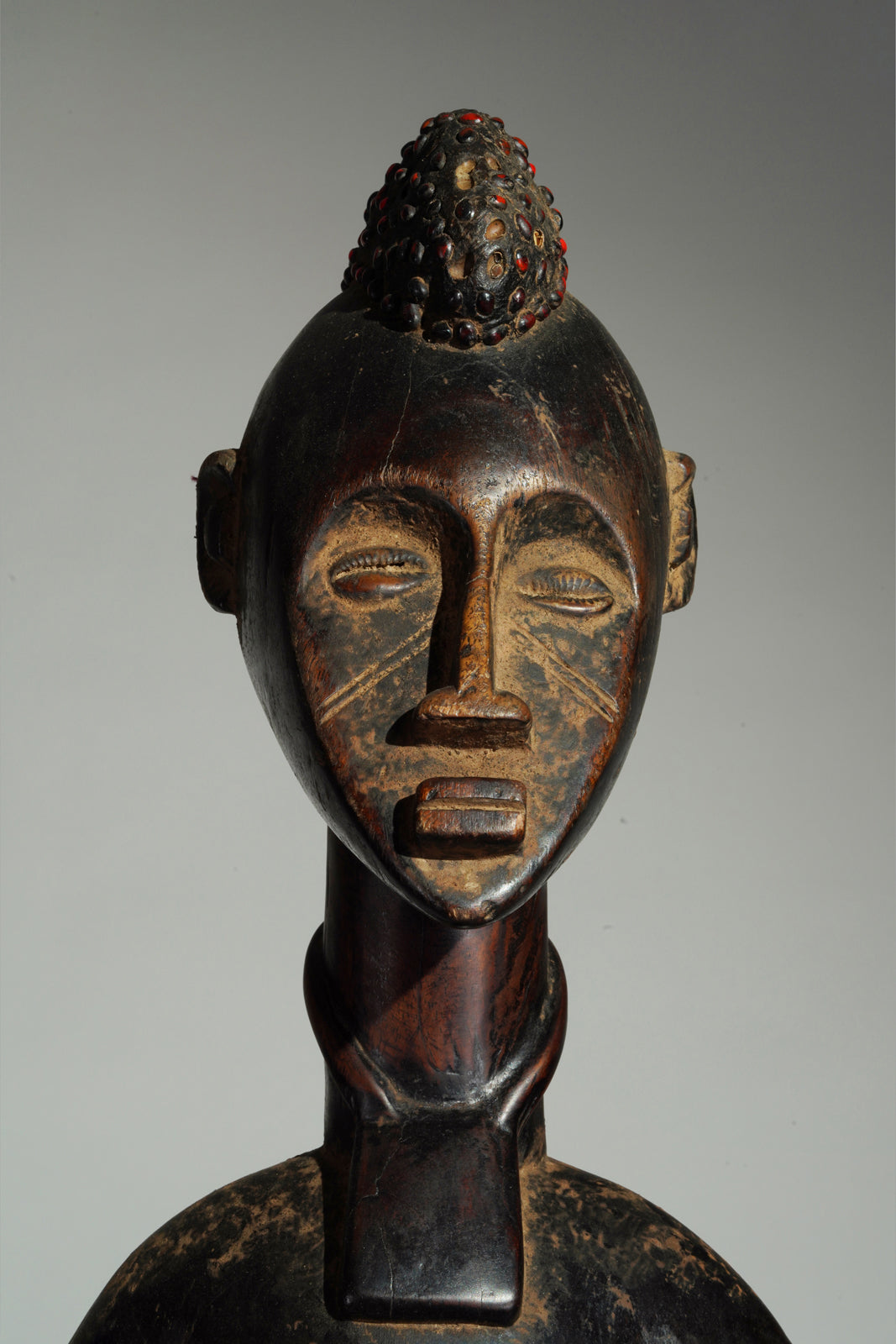
A Senufo statue called Deble, Tingrela region, Ivory Coast.
This anthropomorphic carved wooden Déblé statue (or rhythm mallet) depicts a stylized female figure used by the Poro secret society.
The face has a sleek, concave profile, shaped like a heart or a half-moon, characteristic of Senufo statuary. A long, slender, pointed nose divides the face down the center, overlooking a protruding mouth. The top of the skull is crowned by a high, narrow, and finely textured sagittal crest, imitating a traditional headdress adorned with reddish beads on blackened latex. The head rests on a sturdy, elongated neck, marked at its base by a necklace or a raised fold. The torso is extremely elongated, vertical, and tubular. Two firm, pointed, and conical breasts are carved in relief on the upper chest, adorned with fine linear scarifications. The long, slender arms extend from the torso, forming two large symmetrical loops. The stylized hands rest on the lower abdomen, just above a pubic area textured with small geometric patterns in a checkerboard or dotted design. The lower part features short, stocky legs, bent at the knees, contrasting with the elongation of the torso. The feet merge into a thick, heavy, cylindrical base shaped like a pestle. This massive part was once used to strike the ground rhythmically to mark the tempo of funerals and agrarian rites. The entire monoxyl piece has a dark, smooth, and glossy patina on the grip areas (arms and torso), with traces of cracks, while the base has a rougher, eroded appearance due to ritual impacts against the ground.
Certain stylisic similarity to the Senufo Pounder (90,5 cm) of the Musée Fabre, France/ Museum Cleveland, Ohio, USA, which has softer and less antagonistic forms, It comes from the same region. 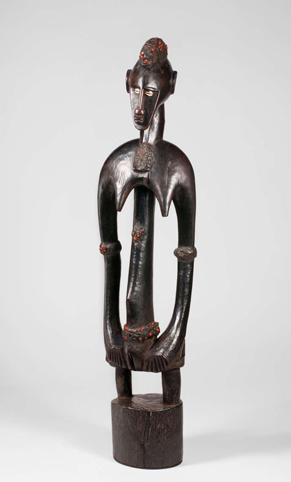
Source: Susan Elisabeth Gagliardi,Cleveland Museum, Ohio, USA.Senufo Unbound, pate 46/47 (mostly wellknown is the "Western Provenance" ,in the description we read "unknown artist".Perhaps one could say that this is a postcolonial, Western view of Africa, because the makers of these sculptures do not see themselves as "artists" in Africa. They are craftsmen, often blacksmiths, who, despite being integrated into village communities, usually live on the outskirts of the villages. Learning where these villages are and how the carvers influenced each other might say more about Africa than a "family tree" of Western owners. But that would mean that anthropologists do field research in Africa instead of running museums that are under the influence of the art trade.
Lit.: A lecture of Dr. Junker, "der Originalzustand.. Wo ist er geblieben?" Gottschalk Burkhard, "Senufo, Massa und die Statuen des poro" 2002: 43; Glaze Anita J., "Art and Death in a Senufo Village", Indiana University Press, Bloomington 1981. A related eyemplare: Robert Goldwater, Senufo Sculpture from West Africa, New York, 1964, ills. 88 and 88a, Werner Gillon, Collecting African Art, London, 1979, p. 50, fig. 38 William Rubin, "Primitivism" in 20th Century Art: Affinity of the Tribal and the Modern, New York, 1984, vol. 1, p. 131 William Rubin, Le Primitivisme dans l’art du 20e siècle. Les artistes modernes devant l’art tribal, Paris, 1987, p. 131 Jacques Kerchache, Jean-Louis Paudrat and Lucien Stéphan, L'art africain, Paris, 1988, p. 82, pl. 34, Jacques Kerchache, Jean-Louis Paudrat, and Lucien Stéphan (eds.), Die Kunst des Schwarzen Afrika, Freiburg, 1989, p. 80, pl. 34 Jacques Kerchache, Jean-Louis Paudrat and Lucien Stéphan, Art of Africa, New York, 1993, p. 82, pl. 34 Mary H. Nooter, Secrecy: African Art that Conceals and Reveals, New York, 1993, p. 155, cat. 79.
Some of the information is generated by artificial intelligence and is based on published sources from the fields of ethnography, archaeology, and art history.
According to Gottschalk, who tried to make a typolgy of the Senufo Déblé, these exemplares would probably be submitted to the group of the kulibèlè and not the fonombèlè.
"Während die ersteren (fonombèlè) entweder wegen mangelnder Fähigkeit zu feinerer Arbeit (the fonombèlè are the blacksmiths in the Senufo society) oder als bewußt eingesetztes Stilmittel die klaren und wuchtigen Formen, die kontrastierenden Waagerechten und Senkrechten weitgehend so beließen, wie sie bei der Festlegung der Proportionen entstanden waren, bemühten sich die kulibèlè (the traditional carver) um ein weiches Ineinanderfließen der Körperteile, soweit sie nicht den Stil ihrer älteren Brüder in ihre Arbeit aufnahmen oder ihn mehr oder weniger kopierten." Source: Burkhard Gottschalk
More realistic sounds the opinion of Glaze, who described the difficulties of a stylistic typology according to both ethnic groups after she did fieldwork around kufulo (region of Dikodougou). Anita J. Glaze, 81.

A Rhythmpounder from the same region, also collected in the Nafou region, which we sold four years ago.
Informant Bakari
MAZ16318
Height: 113 cm
Weight: 9.1 kg