

Galerie Wolfgang Jaenicke
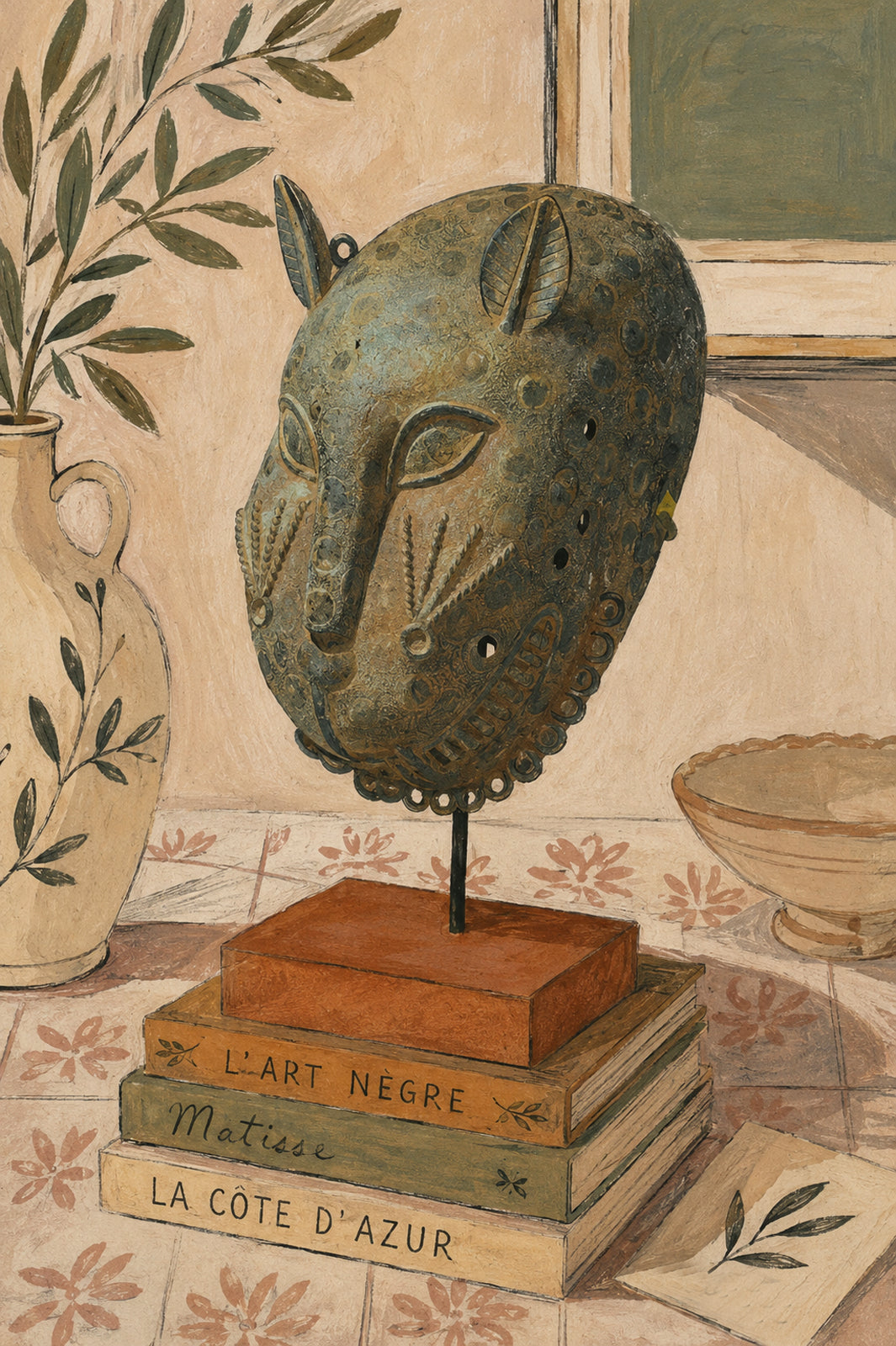
A rare Benin- or Ife-leopard mask
A rare Benin- or Ife-leopard mask
Couldn't load pickup availability
A rare Benin- or Ife-leopard mask, In its form, construction, and technical conception, the present leopard mask displays remarkable parallels with a small group of masks from historical Ife, among which the so-called Obalufon mask occupies a particularly significant position. Frank Willett proposed that this mask may have been used in connection with royal funerary or commemorative rituals. Unlike the well-known cast heads from Ife, it was in fact conceived as a wearable mask: eye openings allowed the wearer to see, while numerous perforations apparently served to attach additional elements—headgear, a beard, costume, or other organic components.
A comparable functional logic may also have informed the present leopard mask. Loops and openings, together with its sculptural design oriented toward a frontal presentation, suggest that it too may originally have formed part of a more elaborate mask costume or ceremonial ensemble. In this case, the surviving metal object would represent only the durable core of what was originally a considerably more complex appearance incorporating metal, textiles, and possibly other organic materials.
Of particular interest is the iconographic shift from the human to the animal countenance. This need not argue against a related ritual function. Rather, within a courtly ritual system, the leopard mask may have embodied a complementary manifestation of authority: while the anthropomorphic mask made present the personal or dynastic identity of a ruler or ancestor, the leopard may have visualized the superhuman, dangerous, and sovereign dimension of royal power.
The striking structural similarities therefore permit the working hypothesis that anthropomorphic and zoomorphic metal masks may have fulfilled different roles within a related ceremonial context. Should metallurgical, technological, and chronological investigations confirm that the leopard mask originated within the cultural and artistic sphere of classical Ife metalworking, the object would represent a hitherto scarcely documented zoomorphic extension of the known mask repertoire.
Given the extraordinary rarity of such a type, however, this attribution should at present be regarded as a hypothesis rather than as an established identification. It is precisely the combination of unusual iconography and functional parallels with the Obalufon mask that makes the object a particularly significant candidate for further technical, art-historical, and comparative investigation.
The price is without the price for the TL analysis but can be done within four weeks.
Some of the information is generated by artificial intelligence and is based on published sources from the fields of ethnography, archaeology, and art history.
Invt. No. MAZ22164
Height: 31 cm
Weight: 3.2 kg (incl. stand)