

Galerie Wolfgang Jaenicke
A Katsina terracotta head
A Katsina terracotta head
Couldn't load pickup availability
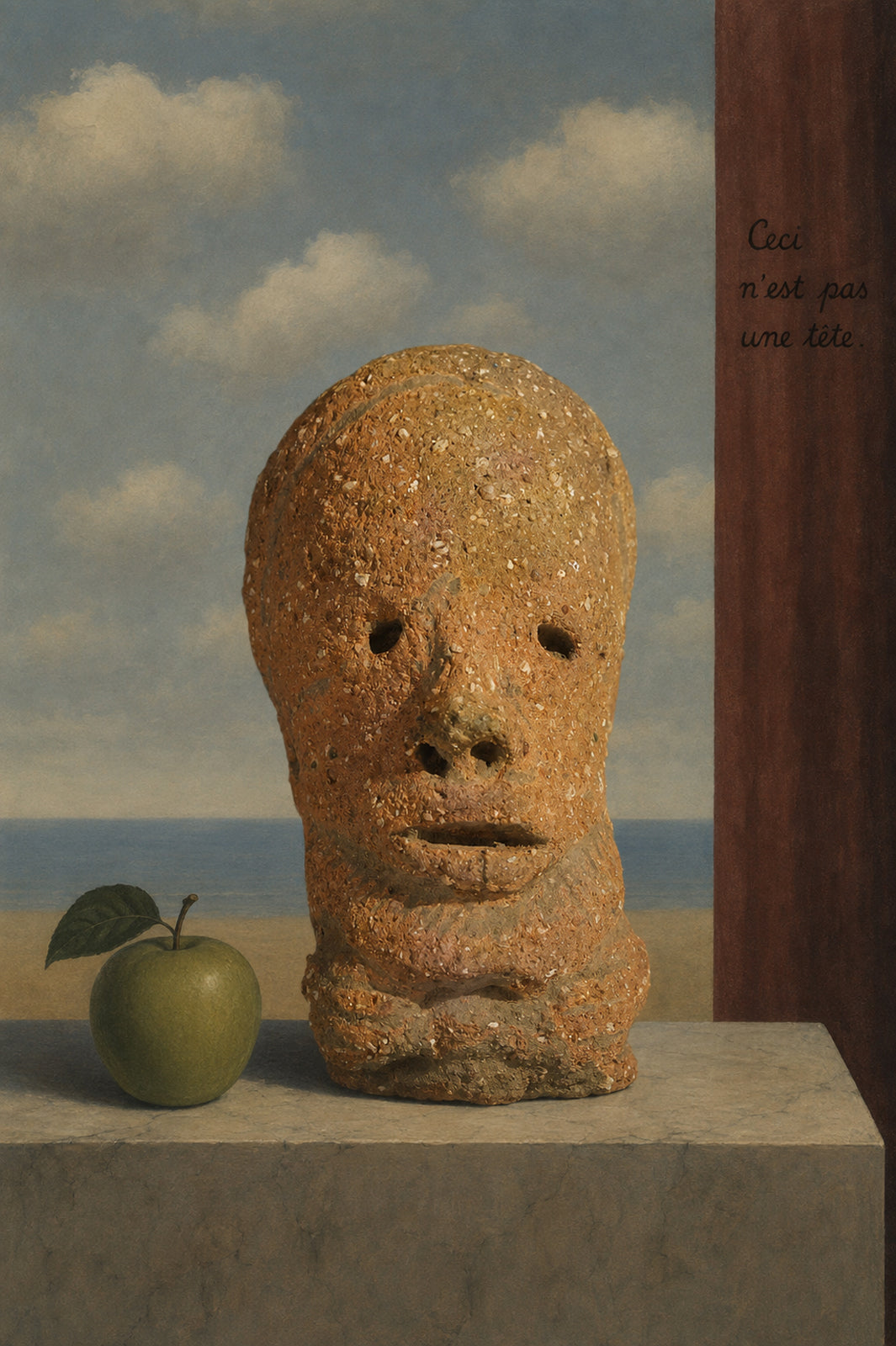
A Katsina terracotta head, collected in the Kaduna region, Nigeria, incl stand.
This fragmentary terracotta head from the Katsina-Ala region of Nigeria is characterized by a deliberately stylized depiction of the human figure: the ovoid, prominently developed skull dominates a narrow face with simplified features, marked by large, pierced eyes, a protruding nose with open nostrils, a horizontal mouth with modeled lips, and ears that are merely hinted at; below the chin, part of the torso remains, showing limbs drawn forward, with the hands and forearms suggested by compact volumes and parallel incisions. The clay, which is orange-red in color, has a particularly grainy texture, laden with numerous light-colored mineral inclusions, while the surface retains, in places, grayish bands and lines that follow the curve of the skull, the outline of the face, and certain parts of the body; these may correspond to surface treatments, engobes, or traces of ancient coloring, though material analysis does not allow for a definitive determination here. The clean perforations of the eyes, nostrils, and ears contribute to an aesthetic in which negative space is integrated into the modeling and likely also facilitated the firing of the hollow sections. The emphasis on the head—which is disproportionate to the body fragment—along with the frontal orientation and anatomical simplification, places the object within a conception of representation where the individual is sought less as a naturalistic portrait than as a condensed physical and social presence. In the archaeological context of central and central-eastern Nigeria, Katsina-Ala is one of the sites associated with the significant tradition of terracotta sculpture generally linked to the Nok culture, examples of which have been discovered across a vast geographical area; several figure fragments originating specifically from Katsina-Ala are now documented in Nigerian and international museum collections. (British Museum) From an anthropological perspective, this fragment can thus be viewed as the remnant of an effigy whose exact function remains difficult to establish outside its archaeological context—ancestral representation, a status figure, or an object of ritual significance are among the hypotheses generally considered for this body of work— its fragmentary state, its expressive modeling, and the highly visible materiality of the terracotta now provide as many clues to its technical history as to its archaeological trajectory.
“The geological processes of erosion and accumulation are of such intensity in West Africa that in the curse of a few centuries large earth movements have been caused. Unlike in Europe archeological work is therefore particularly difficult and almost exclusively limited to chance finds. Such a coincidence brought the light in the 1940s the earliest evidence of African sculptures outside of Egypt. After the place where the first clay head was found in Jaba village of the same name of the Zaira province of Nigeria which was found as early as 1928.
Source: Karl Ferdinand Schaedler, Erde und Era, 2500 Jahre Afrikasnische Kunst aus Terrakotta und Metall, Edition Minerva, 1997, p.195
Katsina terracotta heads are generally modeled in a naturalistic to semi-naturalistic style, with carefully articulated facial features. The heads often display elongated oval faces, high foreheads, prominent noses, and pursed lips, while the eyes are frequently rendered as pierced or incised almond shapes. Stylized scarification marks, coiffures, or headgear can be seen on many examples, providing clues to status, ethnicity, and social identity. The use of terracotta as a medium enabled subtle surface modeling, with traces of burnishing or slip application suggesting a concern for both realism and durability.
Archaeological and ethnographic evidence indicates that such heads were integral to ritual and possibly funerary contexts. Some were discovered in shrines or buried deposits, leading scholars to suggest that they represented ancestors, spirits, or significant community figures whose presence mediated between the living and the supernatural. As with Nok and Sokoto terracottas, fragmentation of heads and figures is common, either due to deliberate ritual deposition or the effects of time.
The Katsina terracotta heads occupy a liminal space between commemorative portraiture and spiritual effigy. Their serene, contemplative expressions suggest an enduring presence meant to protect or sanctify the community. According to Ekpo Eyo, a leading authority on Nigerian antiquities, “these terracotta visages bear silent witness to an ancient ceremonial life, projecting both human individuality and sacred continuity.”¹
In the history of African art, the study of these heads contributes to understanding the early urban cultures of Hausaland, their trade networks, and their interactions with broader Sudanic and Sahelian cultural currents. They also represent a continuity of ceramic sculpture that predates the rise of Islamic Hausa states, linking the material culture of early West African societies with later courtly traditions.
Ekpo Eyo, Two Thousand Years of Nigerian Art (London: Ethnographica, 1977), 54.
References
Eyo, Ekpo. Two Thousand Years of Nigerian Art. London: Ethnographica, 1977.
Fagg, William. Nigerian Images. London: Lund Humphries, 1963.
Shaw, Thurstan. Nigeria: Its Archaeology and Early History. London: Thames and Hudson, 1978.
Willett, Frank. African Art: An Introduction. London: Thames and Hudson, 1971.
Some of the information is generated by artificial intelligence and is based on published sources from the fields of ethnography, archaeology, and art history.
Inv. No. MAZ21515
Height: 16 cm
Weight: 1.4 kg (incl. stand)