

Galerie Wolfgang Jaenicke
A Guro mask
A Guro mask
Couldn't load pickup availability
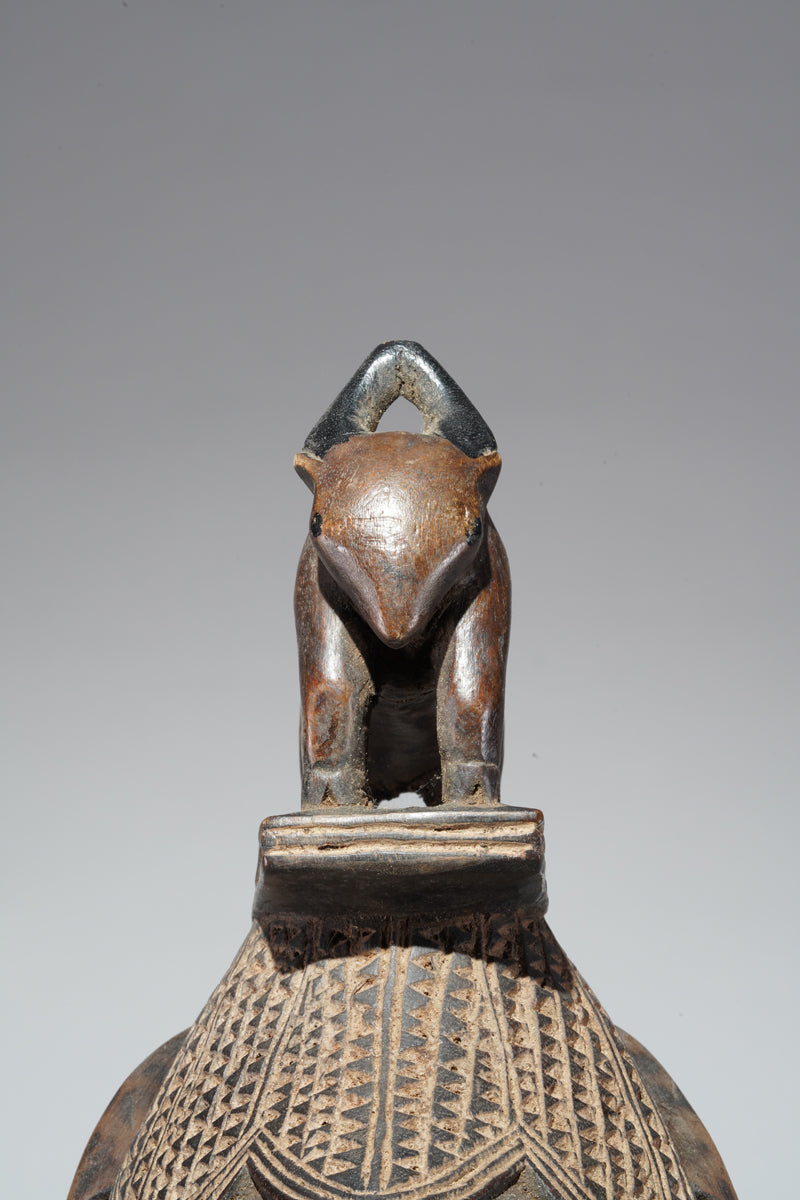
A Guro mask, Ivory Coast, colected in the region of Gohitafla, of oval hollowed form, surmounted with a ram; fine shiny, blacked patina, incl. stand, provenance Bakari Bouaflé, Abidjan.
The Guro masks from Gohitafla, Ivory Coast, are part of a rich sculptural tradition used in ceremonial performances by the Guro people, an Akan-speaking group. These masks are highly stylized, visually striking, and performative objects, serving as both artistic expressions and instruments of social and spiritual communication.
Guro masks are primarily associated with rituals, funerals, initiation ceremonies, and public festivals. They are not worn randomly; each mask type has a defined role, often representing ancestral spirits, animals, or social archetypes. The masks mediate between the human and spiritual realms, embodying moral, protective, or instructive powers during performances.
A defining feature of Guro masks is their geometric abstraction combined with expressive detail. Faces are often elongated or triangular, with exaggerated features such as prominent foreheads, pointed chins, or high-relief eyebrows. Some masks incorporate animal motifs, like antelope horns or bird beaks, which carry symbolic associations with agility, cunning, or vigilance. Scarification patterns, painted designs, and added materials such as fibers or cloth may enhance their visual impact and signify lineage, rank, or spiritual potency.
Performance is central to the meaning of these masks. Dancers wear them with elaborate costumes, and their movements, rhythm, and interaction with the audience activate the mask’s power. The masks communicate messages about morality, social cohesion, and ancestral memory, making them dynamic tools rather than static art objects.
In summary, Guro masks from Gohitafla combine abstract formal design, symbolic representation, and performative function. Their significance emerges through ritual use, linking aesthetic excellence with social and spiritual authority.
Barth, Heinz. Masks of the Guro: Art and Ritual in the Ivory Coast. London: Thames & Hudson, 1991.
– Focused study on Guro mask types, symbolism, and ritual performance.
Perani, Judith. African Art: Guro Masks of the Ivory Coast. New York: Harry N. Abrams, 1982.
– Includes photographs, descriptions, and analysis of Guro ceremonial contexts.
Vogel, Susan Mullin. African Aesthetics: The Guro Tradition. Los Angeles: UCLA Fowler Museum, 1988.
– Explores stylistic features, geometric abstraction, and social meaning of Guro masks.
Cole, Herbert M., and Chantal T. Cole. African Art and Leadership: Masks of the Guro. Bloomington: Indiana University Press, 1996.
– Discusses the social and spiritual functions of masks in ritual, initiation, and public performance.
Hagen, Ursula. Masks and Society: Guro Ritual and Performance. Stuttgart: F. Steiner Verlag, 2001.
– Examines mask use in ceremonies and the performative aspect of Guro masks.
CAB30144
Height: 37 cm
Weight: 1,3 kg incl. stand