

Galerie Wolfgang Jaenicke
A female Baule figure
A female Baule figure
Couldn't load pickup availability
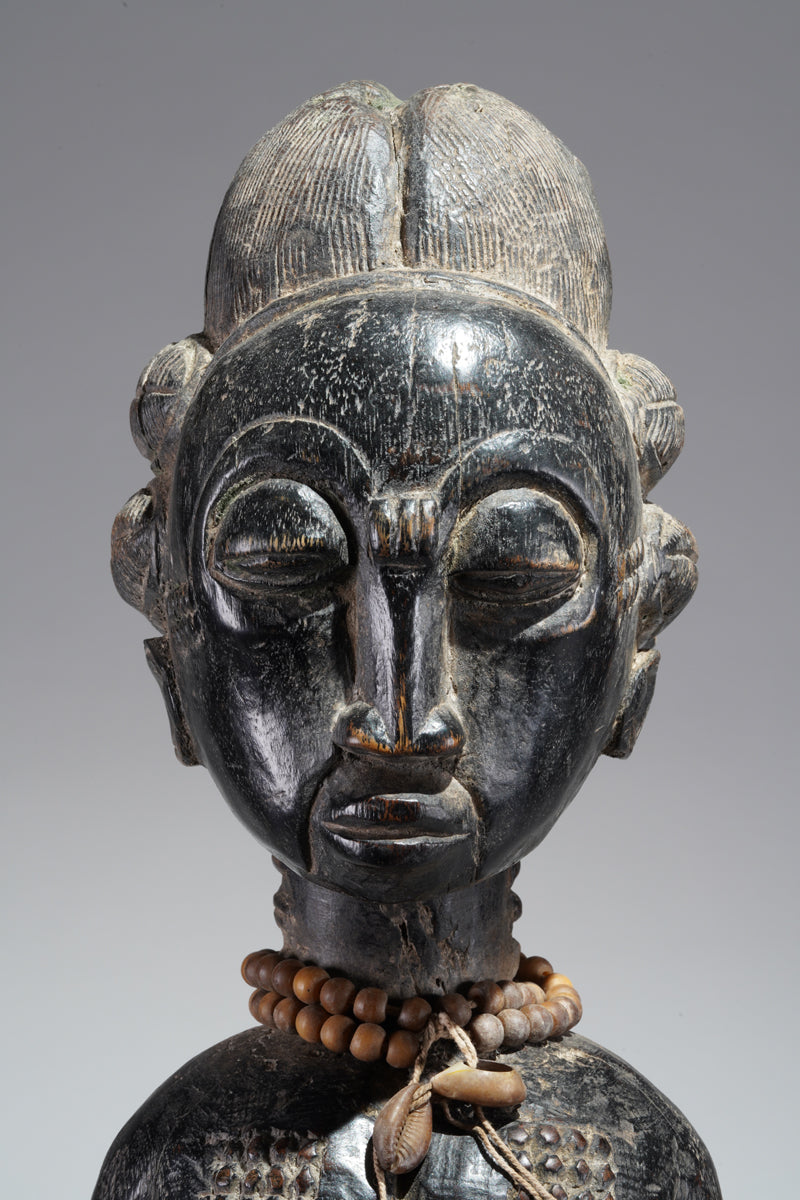
A female Baule figure, Ivory Coast, collected in the region of Daoukro, seated on an Ahanti stool, with arms close to the body, the hands touching the abdomen, the whole body covered with scarification patterns, decorated with rows of fine colourful pearls, remarkable the position in which the figure is placed on the wooden stool; fine blacked, shiny patina, provenance Bakari Bouaflé, Abidjan.
Scarification patterns on Baule figures from Côte d’Ivoire serve multiple interconnected functions, combining aesthetic, social, and symbolic significance. These patterns often reflect ideals of beauty, social status, or group identity, rendering the figure culturally “complete” even when it does not depict a specific individual.
Ritually, the scarification marks enhance the figure’s spiritual potency. Figures used in ancestor veneration or protective contexts carry these patterns as symbols of moral integrity, social order, and cultural values, linking the material object to ethical and cosmological principles.
Aesthetically, the scarification creates rhythm and texture across the surface, emphasizing the figure’s contours and contributing to the Baule preference for balance, clarity, and controlled form. In this way, the patterns function simultaneously as markers of identity, conveyors of ritual power, and elements of visual harmony, making the figure socially meaningful, spiritually efficacious, and visually compelling.
Sullivan, Lynne. Baule: African Art from the Ivory Coast. New York: The Metropolitan Museum of Art, 1990.
– Comprehensive museum catalogue with detailed discussion of Baule figure types, scarification, and aesthetic principles.
Perani, Judith. The Art of the Baule. New York: Harry N. Abrams, 1981.
– Focuses on stylistic and symbolic features of Baule sculpture, including body markings and ritual context.
Polanyi, Karl. The Social Life of Things: Commodities in Cultural Perspective. Cambridge: Cambridge University Press, 1986.
– Includes discussion on African figurative art, social function, and symbolism.
Vogel, Susan Mullin. African Aesthetics: The Baule Tradition. Los Angeles: UCLA Fowler Museum, 1988.
– Analyzes formal aesthetics, scarification patterns, and the social significance of Baule figures.
Cole, Herbert M., and Chantal T. Cole. African Art and Leadership: The Baule Example. Bloomington: Indiana University Press, 1996.
– Explores the relationship between figurative sculpture, social hierarchy, and ritual practice.
CAB30144
Height: 69 cm
Weight: 4,5 kg