

Galerie Wolfgang Jaenicke
A Benin Bronze ram
A Benin Bronze ram
Couldn't load pickup availability
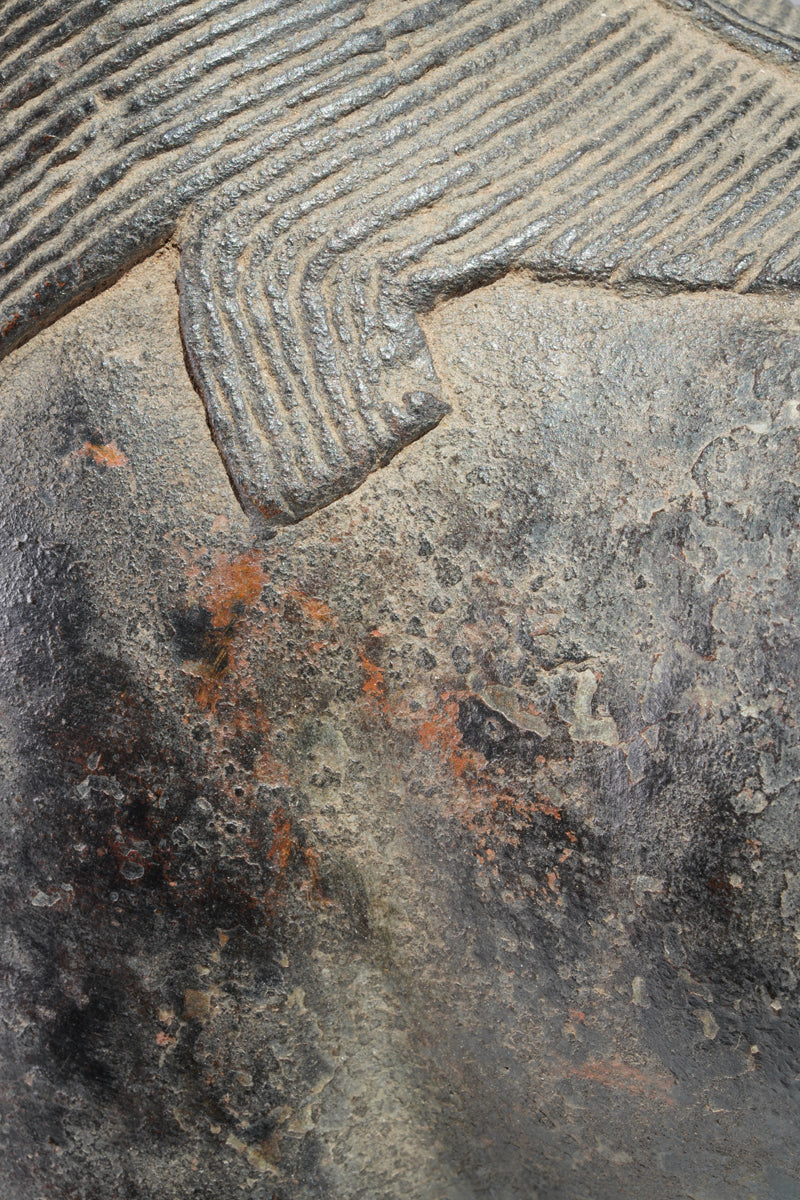
A Benin Bronze ram, Powerful in its expression, produced using the lost wax method. The patina indicates great age, which is confirmed by TL analysis.
Among the treasures of African art, the Benin Bronzes hold a singular place: objects of remarkable beauty that also serve as intricate symbols of political and spiritual authority. Among these, the bronze ram stands out—not for its ferocity or elegance, but for the quiet gravitas it conveys.
Crafted by the Edo people of the Kingdom of Benin, in what is today southern Nigeria, the bronze ram is a testament to a civilization where artistry and rulership were inseparable. These figures were cast using the lost-wax technique, a sophisticated method that allows for intricate detailing and enduring form. Yet the artistry is never purely aesthetic. Every curve, every coiled horn, every textured surface carries meaning: the ram embodies strength, leadership, and sacrificial power. Placed upon royal altars, it mediates between the spiritual and temporal realms, linking the Oba, the king, to both his ancestors and his subjects.
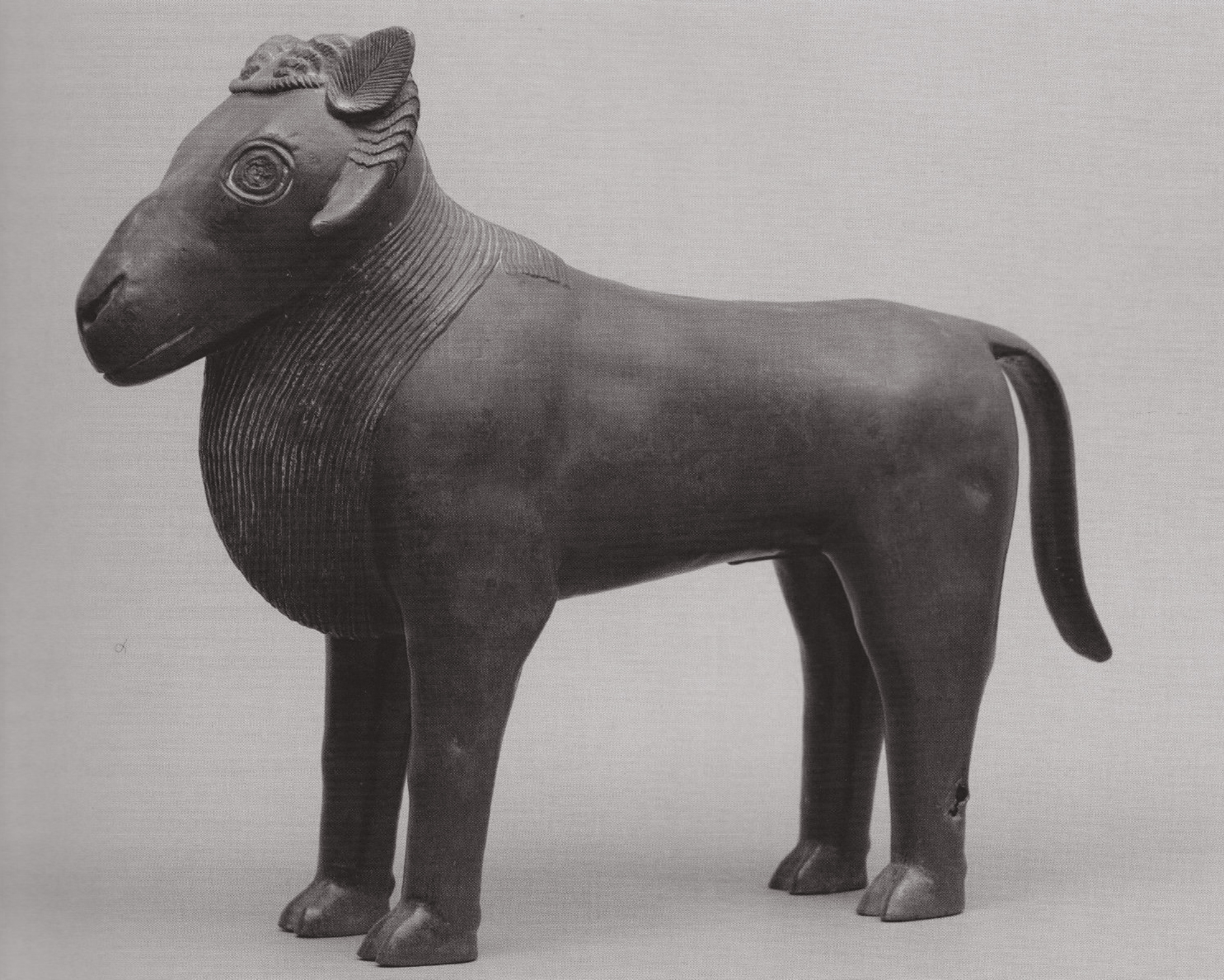
British Museum, Benin. Könige und Rituale. Höfische Kunst aus Nigeria, Wien 2007, S. 433.
In the broader iconography of Benin, animal figures operate as emblems of authority and morality. The leopard, for instance, personifies courage and political dominance, echoing the Oba’s own prowess, while the mudfish evokes duality—the liminal space between land and water, mortal and divine. In comparison, the ram is less aggressive than the leopard, less mythic than the mudfish; yet its significance is no less profound. Its presence signals ritual obligation and the disciplined might that undergirds kingship.
The Benin bronze ram thus invites a double gaze: one that appreciates the meticulous craftsmanship, and one that interrogates the political and spiritual narratives it enshrines. In the elegant heft of its form lies a story of rulership, ritual, and resilience—a reminder that in Benin, as in many kingdoms, art was never merely ornamental; it was sovereign.
Philip Dark, die Kunst von Benin, Prag 1960, S. 58/ 59, 87;
Barbara Plankensteiner, Benin. Könige und Rituale. Höfische Kunst aus Nigeria, Wien 2007, S. 433.; British Museum, London William Fagg, Bildwerke aus Nigeria, München 1963, S. 75
CAB31169
Height: 40 cm
Length: 44 cm
Weight: 8 kg
Kingdom of Benin, Nigeria, 16th/17th century Yellow cast iron, 34 x 44 x 14 cm The National Commission for Museums and Monuments, Nigeria, Inv. No. 53.22.2 Aquamaniles were introduced to Europe in the Middle Ages; they originated in Muslim countries, where such zoomorphic containers were used for ritual washing. They were also used liturgically in Europe, but by the 15th century they had also been integrated into secular table culture. Portuguese traders probably brought an example to the Oba of Benin as a gift, or a damaged example was brought there as scrap metal for reuse in a foundry. It is doubtful that such vessels were imported via the trans-Saharan trade, since aquamaniles are not found anywhere else in West Africa and had been abandoned in the Islamic world centuries earlier. The Oba used ram aquamanile to wash his hands during the final rites of the Ague ceremony, which was a purification ceremony associated with the new yam harvest (Curnow 1997a: 50).
The ram is a symbol of masculinity in Benin; in earlier centuries, ancestral altars were decorated with wooden ram heads instead of human heads, and there were also bronze ram pendants. The specific significance of the ram in the Ague ceremony is unclear, as it is only one of several animals sacrificed during the festival. Rams also represent perseverance. They are occasionally identified with Okhuaihe, a deified hero in Benin who is associated with Oba Ewuare, who first celebrated Ague as a ceremony in the 15th century. Although Okhuaihe has no obvious connection to these rituals, this idea cannot be ruled out from the outset, as changes may have been made over time. The British Museum has a nearly identical vessel with a hole in the side, which may have made it necessary to cast the piece in Lagos.
Dark (1960: 56) initially dated the ram in the British Museum to the 18th century, Fagg (1963a: note to Fig. 45) placed it in the 16th to 17th century; later Dark (1973:91) suggested the 17th century for the Lagos example. Neither of them had any evidence for the dating. What is certain is that two pieces do not show the overly elaborate surface decoration of the 18th century examples. They may be works from the 16th century: that was when Oba Esigie developed Ague into an important festival, and the naturalistic depiction (except for the stylized eyes and leaf-like ears) is appropriate for that period. No other ram aquamaniles are known, but the Benin Museum has a pair of simple, decidedly more abstracted bronze ram statues that are only slightly smaller.
Kathy Curnow