

Galerie Wolfgang Jaenicke
Royal Hip Ornament (Uhunmwu-Ẹkuẹ)
Royal Hip Ornament (Uhunmwu-Ẹkuẹ)
Couldn't load pickup availability
Royal Hip Ornament (Uhunmwu-Ẹkuẹ), so-called Udo Style,
Brass, cast by the lost-wax process, incl stand
Kingdom of Benin, Nigeria
Private Collection
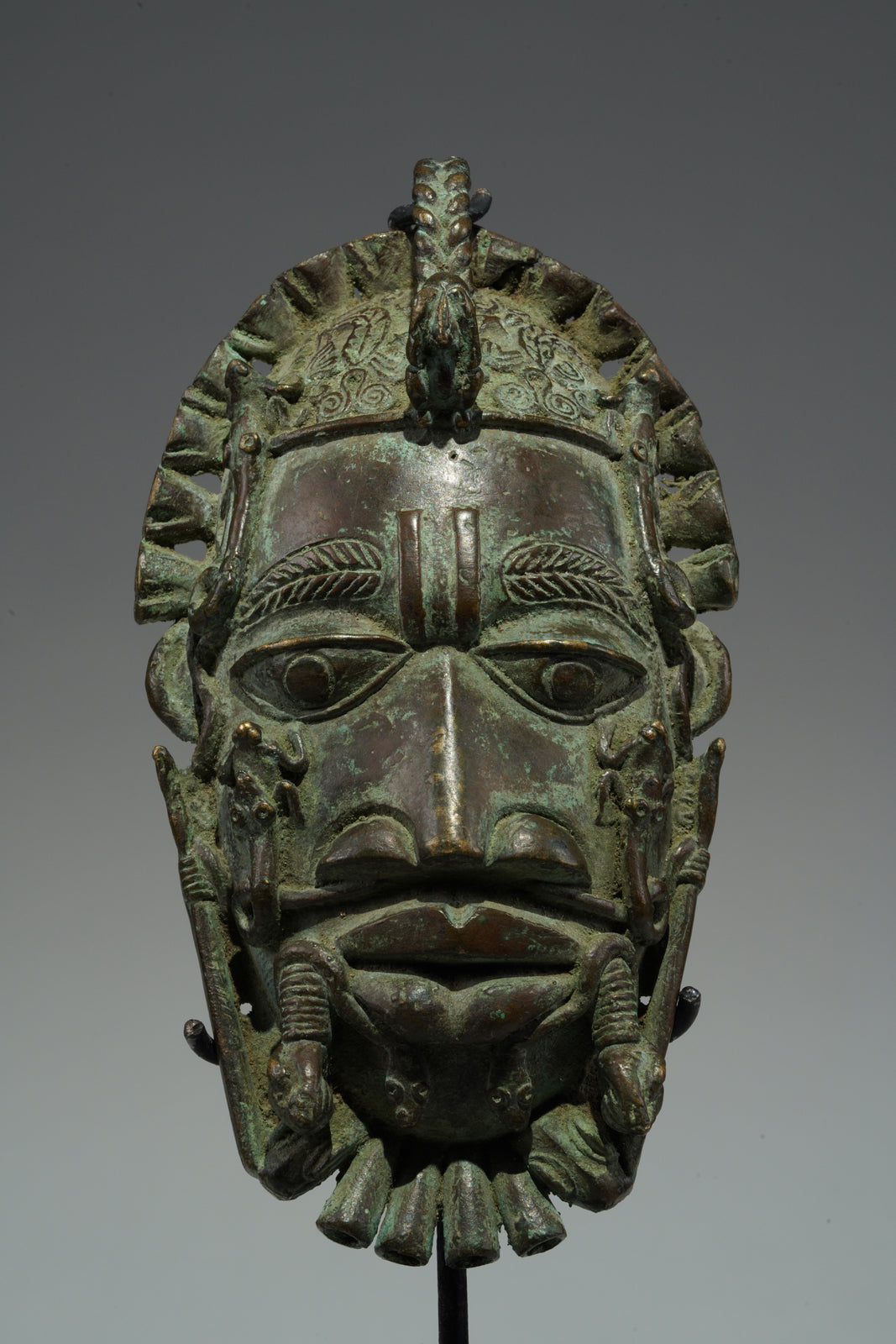
This exceptional royal hip ornament (Uhunmwu-Ẹkuẹ) belongs to the highest-quality surviving works of the Benin court foundries. It represents the so-called Udo Style, a recognisable stylistic group within Benin court art, characterised by particularly powerful sculptural modelling, vibrant ornamentation, and a pronounced sense of spatial depth.
The face displays the idealised symmetry typical of royal representations, yet it is animated by a forceful plastic treatment and refined individual details. The almond-shaped eyes are deeply set beneath carefully engraved eyelids; two vertical scarification lines on the forehead are accompanied by finely incised eyebrows. The strongly modelled nose, slightly open mouth, and distinctive treatment of the lips lend the face a striking presence and an expression of inner tension.
A defining feature of this ornament is its exceptionally rich sculptural composition. Along the edges of the face run finely modelled snakes, whose curving bodies elegantly frame the composition. Beneath the mouth appear pairs of crocodiles, their stylised bodies forming the lower termination of the design. These animals are far more than decorative elements; they belong to the royal symbolic system of Benin and refer to protection, power, wisdom, and the Oba’s ability to control the various realms of the visible and invisible world.
Particularly impressive is the tall, openwork coral crown, elaborately constructed in relief. Above an ornamented crown band rises a richly articulated structure with openwork passages and finely modelled motifs, evoking the appearance of a royal crown originally covered with coral beads. At the centre rises a strongly twisted coral-like finial, whose sculptural effect is further enhanced by the open construction. This complex openwork technique ranks among the most technically demanding achievements of the Benin court foundries and demonstrates an extraordinary mastery of the lost-wax casting process.
Of particular appeal is the surface, which has developed over several centuries. Dark brown areas of the metal alternate with a finely evolved olive-green to light green noble patina, preserved especially in the recessed areas and along the sculptural ornaments. This natural ageing process gives the brass exceptional depth and allows the delicate relief structures to emerge with remarkable clarity.
Within Benin court art, several distinct stylistic traditions can be identified. While the famous hip ornaments of the classical Benin style – particularly the examples known as Idia masks – are characterised by calm surfaces, clear geometry, and an almost architectural restraint, the so-called Udo Style follows a distinctly more dynamic aesthetic principle. The faces display stronger sculptural modelling and greater spatial depth; the border ornamentation appears more animated and organic; animal representations are more elaborate and more closely integrated into the overall composition. This is further enhanced by elaborate, often openwork crowns with complex sculptural constructions. Whereas the classical Idia masks derive their impact primarily from the perfect balance of their proportions, works of the Udo Style achieve their particular fascination through the combination of royal monumentality with extraordinary decorative richness and sculptural abundance.
The term “Udo Style” should be understood as a modern art-historical working designation. It does not represent a historically documented stylistic term from the Kingdom of Benin itself, but rather serves to classify a group of closely related bronzes whose formal language differs noticeably from the classical court style. No contemporary name for this workshop or stylistic tradition is currently known. The term has become established primarily among Benin specialists, within international art dealing, and in collection research, although its precise definition has not yet been uniformly established in scholarly literature. Its use should therefore be understood as a modern typological classification rather than as a historically recorded designation.
This group of works nevertheless demonstrates convincingly that the Benin court foundries did not follow a rigid artistic canon. Rather, within royal art there existed a remarkable stylistic diversity, in which different workshops or artist groups developed their own formal characteristics while maintaining the iconographic and ceremonial functions of royal insignia. It is conceivable that the so-called Udo Style represents either an independent workshop tradition or a later developmental phase within the court foundries. Due to the incomplete historical record, however, this interpretation must remain an art-historical hypothesis.
Uhunmwu-Ẹkuẹ were not masks in the literal sense, but ceremonial hip ornaments of the Oba. They were worn attached to a belt during important court rituals and served as references to revered ancestors or distinguished members of the royal dynasty. The term “Hip Mask”, commonly used in Western literature, describes only the manner in which these objects were worn; the original designation preserved in Benin oral tradition is Uhunmwu-Ẹkuẹ.
The combination of supreme technical mastery in bronze casting, complex iconographic symbolism, an exceptionally well-preserved historical patina, and the distinctive formal language of the so-called Udo Style makes this ornament an outstanding testimony to the court art of the Kingdom of Benin and one of the most remarkable examples of this rare stylistic group.
Inv. No. MAZ18783
Height: 16 cm
Weight: 640 g (incl. stand)